Saturday, March 26, 2022

ENCOURAGING BOOK-READING FOR PLEASURE: KHALID MASOOD

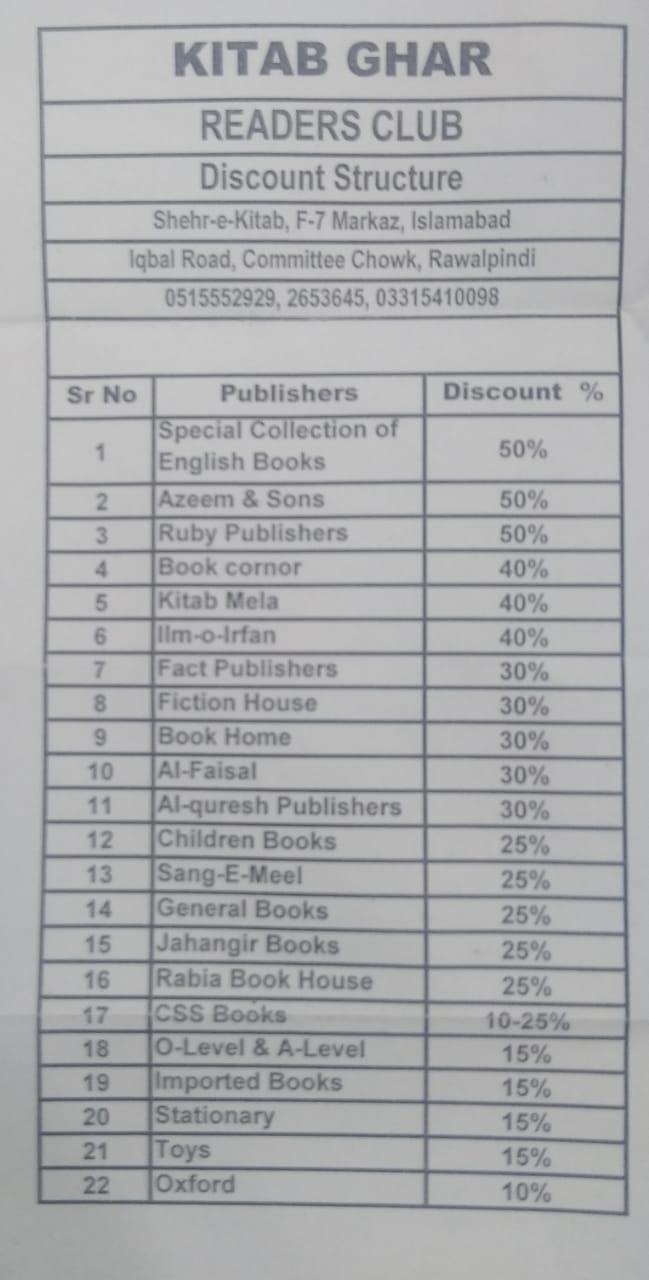
An avid booklover, a fervent Urdu literature critique, a dedicated publisher and an owner of ‘Kitaab Ghar’, Khalid Masood says, “Kitaab Ghar (established 1948) has, recently, given incentive to book-readers to avail 50% rebate on purchase of books for a year time and that too for unlimited buying on a meagre membership fee of Rs: 500- that will instantly consumed on 50% discount of customers’ first visit at both outlets of Kitaab Ghar- at Committee Chowk, Rawalpindi and Jinnah Super Market (F-7 Markaz), Islamabad”- a first of its kind from a private entity.


MAHTAB BASHIR

0333-53 63 248

mahtabbashir@gmail.com

ISLAMABAD

"An hour spent reading is one stolen from Paradise."

The dedication and hard work of pioneering publishers, scholars, and book lovers have not come to fruition yet in Pakistan. Publishers have been demanding for decades for book publishing to be recognized as an industry. Despite repeated promises, the government has not taken any steps to materialize this demand.


Sitting in his bookstore named ‘Kitaab Ghar’ at Jinnah Super Market (F-7 Markaz), Khalid Masood says it is very unfortunate to see book-reading culture is on the decline in Pakistan. 


“It gives me pain to see that the habit of reading has been declining among our younger generation. While technology is steadily taking control over individual lives, we must find a way to encourage our children to read. Books are also costly, which is a contributing factor to the situation. Some parents discourage children from reading for pleasure and force them to read textbooks only,” Khalid says adding book reading is a contagious habit- if parents are away from books- their children are least bother to read books.


Also, the publisher opines, “The overuse of technology should be discouraged. The government should set up at least one library in every sector of Islamabad. Students should be encouraged to read books besides textbooks by teachers at school, college and university levels and by parents,” Khalid suggests.


Khalid Masood- Owner Kitaab Ghar
He said for the first time ever in the history of Pakistan, ‘Kitaab Ghar’ has taken this initiative to entice book-lovers through its ‘Readers Club Scheme’- under which we are providing 50% rebate on purchase of books of all genre annually without limit with the membership fee of Rs.500/=   

Khalid Masood maintains that membership card is valid on both outlets of ‘Kitaab Ghar’ of F-7 Markaz (Jinnah Super Market) and Committee Chowk, Rawalpindi.   


Khalid Masood, the CEO of ‘Kitaab Ghar’ narrates that, “Of course, interest is a matter of concern. Your disinterest might work to deter the child from the books. A good practice here is to mix and match varieties of stories, including topics you like. Reading and creating conversation about a book is a key skill which you can easily impart to your child.”


You wonder at times about the state of reading in the world you are part of. There is the sense that it is dying, that indeed these increasing levels of sophistication coming into technology are in essence putting holes into our old habits of reading. Not many people read today, which is a pity. Worse is the knowledge that bookstores are being downsized because business is not good. And what you have in place of these truncated, eventually murdered bookstores is storehouses of all those things that reflect the decline of intellect in our times.


Khalid Masood with his father Malik Ghulam Muhammad
Khalid describes that one of the positive changes brought about by the pandemic is the culture of online activities. “Not only did social media communities on Instagram and Facebook burst open with possibilities, seeing increasingly more book reviews, giveaways, and nation-wide book exchanges organised by readers themselves, but publishers and booksellers, too, adapted a regular practice of holding virtual book launches and discussions with authors.

On the other hand, question remains the same: “How many programmes are there on that ubiquity of television channels that cater to books, to reading? There are nations that are privy to book discussions on television, to authors talking about their works. Surely similar discussions for an hour or so every week can be injected into the television schedules in Pakistan.


There are newspapers, Urdu as well as English, which come up with weekly reviews of books. It would not be a bad idea calling in reviewers and bringing them in touch with readers through the medium of television and radio. There are rivers that nourish the land. And books nurture the soul, he keeps talking.
 

Telling a tale of his laborious father, Malik Ghulam Muhammad, Khalid Masood narrates: his father established ‘Kitaab Ghar’ in 1948 at Committee Chowk, Rawalpindi for the promotion of book and book-reading. After awhile, he started publishing books. He started publishing ‘novels’ of prominent Urdu and English writers. In 1964, he took the initiative for publication of a digest with the name of ‘Kamran Series’ with similar features of ‘Imran Series’- after publicity of Imran Digest, a mushroom growth of such publications took place in Lahore and Karachi.

Since then, Khalid says, he was head over heal in love with book-reading and publishing and indulged in this profession with his father- who died in 2012 at the age of 94. “Now is the time to think about qualitative development. We need to ensure excellence in book writing and publishing. And to do so, readership has to be developed in every part, in every institution of our society,” he says adding to keep publishing sector alive, we really need to bring in meritorious young entrepreneurs in this sector and for doing so, the government should recognize it as an industry.

With his kids Ali Masood & Hassan Masood

He requested National Book Foundation (NBF) high-up’s to to take effective measures to in promotion of book-reading through ‘Shehar-e-Kitaab’ situated in F-7 Markaz and to use its own property more efficiently.    


The World Culture Score Index conducted a global study to measure the amount of time that people around the world spend reading on a weekly basis. The results of this study do not specify what type of material is being read, which could be anything from online news to work e-mails and magazines to books in print. Additionally, the study does not report specific information about the people surveyed (like age, educational level, or sex) or how many people were surveyed.


https://www.worldatlas.com/articles/the-countries-that-read-the-most.html


India topped the list with its citizens reporting an average of 10 hours and 42 minutes a week spent reading. Achieving the number 1 position on the list is quite an accomplishment for this country, which has a literacy rate that is lower than the global average (only 74%). This rate has, however, increased by more than 6 times since the country gained its independence in 1947, which could be an indicator of an increasing interest in reading. This time spent reading does not necessarily reflect the amount of time reading printed books, however, and may include time spent reading online or in electronic format.*

Tuesday, March 1, 2022

HIGHER EDUCATION TURMOIL: DR. ATTA-UR-RAHMAN VERSION

In 2018, the appointment as chairman HEC of someone who was a lecturer at a low-ranking university in the US at the time of his appointment, raised many eyebrows. He had only four publications in international journals, which would have made him ineligible for consideration as an associate professor in a public-sector university in Pakistan which requires 10 publications in recognised journals.

What followed in the higher education sector over the subsequent two-and-a-half years was absolute devastation. This became evident at a major conference in Bhurban, in November 2021, where 180 vice-chancellors of the public- and private-sector universities participated and almost unanimously condemned his policies.

The VCs complained against the unreasonable undergraduate and postgraduate policies developed and imposed by the HEC, without stakeholder consultation; the attempts made to destroy PhD programmes in Pakistan by abandoning the need for a Master’s degree and offering direct admission into a PhD programme on the basis of BSc degree, risking the derecognition of the country’s PhD programmes due to non-conformity with the requirements of the internationally accepted Bologna protocol; the decay of the salary structure under the cherished contractual tenure track system; lack of coordination with the regulatory bodies such as the Pakistan Engineering Council (PEC), the National Business Education Accreditation Council (NBEAC), the Pakistan Medical and Dental Council (PMDC) that provide accreditations and no consultation with the Association of Private Sector Universities of Pakistan (APSUP) that also rejected those new policies outright; massive financial and administrative irregularities that led to NAB inquiries; and the National Research Programme of Universities (NRPU) budget cuts from over a thousand grants annually to less than 100 annually, destroying the research environment in universities as the programme used to provide research funding to young faculty members.

They were also irked at the growth of some 50 new universities during the tenure of the chairman without faculty or funding, resulting in a sharp decline in education quality as these universities poached teachers working at other public- and private-sector universities for their faculty needs – the HEC remained a silent bystander as the destruction took place; the attempts made to destroy existing research centers in universities by proposing to merge their budgets with university budgets and imposing an unwise funding formula; foreign scholarship cuts – from about 1,000 foreign scholarships annually to around 300 per year; and the non-absorption of the returning PhDs, who were forced to hold demonstrations outside the PM residence due to frustration.

These and a host of other complaints piled up in the PM Office, as the prime minister is the controlling authority of the HEC. Finally, after much thought, the Ministry of Education recommended that it would be in the fitness of things if the tenure of the HEC chairperson was two years (extendable) instead of four years as a huge amount of irreparable damage could be done in a four-year-long period by an incompetent individual. The HEC ordinance was accordingly changed.

Immediately after this, the HEC chairman held a number of press conferences falsely claiming that he was removed from office because he dared to audit the accounts of some research centres. After the careful analysis of the available documentary evidence, the Higher Education Commission (HEC), the very organisation that he chairs, stated in its press release that this was completely wrong, and it gave out the following statement:

“There have been incorrect statements made to the press by chairman HEC that he was removed from office because he tried to have the accounts of some research centres in Karachi University audited that he claimed are supervised by Dr Atta-ur-Rahman. The facts are as follows: a) Prof Atta-ur-Rahman has held no administrative position in any research centre or university for the last 20 years. No centres have been operating under his administrative or financial control since the year 2002.

“b) HEC had requested for academic and financial audit of [the] International Center for Chemical and Biological Sciences. The requests were strongly welcomed by the centre in writing. The only requirement of the centre was in connection with the academic audit – that it should be carried out by experts in the relevant fields of chemistry and biology, which was reasonable.

“An academic audit of the International Center for Chemical and Biological Sciences was conducted by 11 international experts in 2018. It was commissioned by the Ministry of Science and Technology and in their report all the 11 foreign experts were unanimous in their praise of the high quality of research work being conducted in the centre, and had recommended additional financial support for it.

“c) The Ministry of Education objected to the funding formula proposed by HEC for all university research centres and pointed out that it was not suitable, without precedence and that it would badly damage research. The issue therefore was never about the auditing of accounts or transparency, as has been wrongly portrayed by Chairman HEC in statements to the press.

“d) HEC had proposed to take away the autonomy and merge the budget of the International Center of Chemical and Biological Sciences with that of the University of Karachi. This was not possible as the government has a formal agreement with UNESCO that its financial autonomy will be maintained. This was pointed out by the Ministry of Education to HEC in writing.

“This centre is the UNESCO Center of Excellence, the TWAS Center of Excellence, OIC Center of Excellence and the WHO Collaborating Center. Its faculty members have won more civil awards and international prizes than any other academic Center in Pakistan, including one Nishan-e-Imtiaz, four Hilal-e-Imtiaz, 13 Sitara-e-Imtiaz and eight Tamgha-e-Imtiaz and many honorary doctorate degrees from foreign universities including the University of Cambridge UK. The work of the Center has been praised by many Nobel Laureates. The accounts of ICCBS are regularly audited by the government and are well maintained. The Center is headed by Prof Iqbal Choudhary, a leading scientist of Pakistan, since 2003”.

The above statements exposed the HEC chairperson’s incorrect statements. The powers of the commission given to the chairperson were withdrawn after he tried to illegally appoint an executive director. These powers are now vested with the HEC executive director.

The Higher Education Commission (HEC) needs a new visionary chairperson who strictly abides with the law and who can restore the respect and admiration that it enjoyed in the first decade of its existence.

The writer is chairman PM National Task Force on Science and Technology, former minister, and former founding chairman of the HEC.

Courtesy: The News

Wednesday, February 23, 2022

VESTED INTERESTS TAKE TOLL ON HEC?

* Chairman HEC warns present crisis to only harm higher education sector
* Says PHDs produced in Pakistan are far below the required levels of competency,
* Academic journals are the biggest scam in higher education
* I am here to rectify the anomalies focusing on autonomy, quality and accountability
* My policy of equal distribution of funding to Centre of Excellence & HEI’s troubles few close to PM


Mahtab Bashir
0333 53 63 248
mahtabbashir@gmail.com
Islamabad


Chairman Higher Education Commission (HEC) Dr. Tariq Javed Banuri has said that since its inception (in 2002), HEC has been working with rudderless policy, I step-in the premises of HEC with a clear cut vision of autonomy, quality and accountability (of/to HEI’s) in the country, however, some beneficiaries of the old policies, including some HEC staff members, did not like these reforms and started to reverse them as soon as I was removed.

Dr. Banuri, who was appointed as the chief of the commission in 2018 by then Prime Minister Shahid Khaqan Abbasi for a protected tenure of 4 years (till May 2022), said that for the last two decades, PHDs produced in Pakistan are far below the required levels of competency, whereas academic journals are the biggest dodge in higher education that the world laughs on us.

He further opined that the measures he took as chairman of HEC to rectify these issues, including, life-long training programs for PHDs, teaching as a requirement for promotions (along with research) and introducing a method of providing funds on the basis of output and research produced by research centres.

In an informal rendezvous at HEC Secretariat, with this scribe, Dr. Banuri quoted, “Every honest man is alone, while a crooked has a battalion with him,” adding he felt immense contentment out of this crisis as people around the world kept on contacting me on daily basis, praising me the way I am standing on principals.

Dr. Banuri, whose’ name, photograph and message has already been removed from HEC official website (www.hec.gov.pk) while the case is sub-judice, said that he has taken firm steps to strengthen senate/ bodies of Universities/ HEI’s, focused on the Scholarships.

“I ensure that all projects pertaining to education were properly scrutinized on the basis of merit. As a result, none of the projects were able to get the approval of the Planning Commission in two years. As soon as I was removed, the same projects were miraculously approved,” he explained.

In a reply to a question, Dr. Banuri said my working relationship with Dr. Attaur Rehman was deteriorated when I talked about funding under a specified formula and said that funding would be given on the basis of performance.

He said the knowledge economy concept became famous in 2000 when China adopted it as a state policy. The idea is that today knowledge (not IT or technology) plays a key role in the production process, far more than natural resources or industrial structure. “Knowledge” covers many areas, including technology, quality enhancement, higher value products, branding, advertisement, and so on. This means we need to educate our children at all levels, primary, secondary, and higher levels, to be able to produce high quality goods and services.

However, the government’s task force on this subject took a bizarre turn. Instead of supporting higher investment in education, it focused exclusively on getting a funding of Rs30 billion per year for unspecified projects. This amount was more than all the money allocated to all the higher education projects proposed by the HEC. “I made sure that any projects pertaining to education were properly scrutinized on the basis of merit. The result was none of the projects were able to get the approval of the Planning Commission in two years. As soon as I was removed, the same projects were miraculously approved.

He said, "in reply to my strict stance on equal distribution of HEI's funds, he said there are number of Nobel Laureates met me on daily basis. And I simply reply, please keep them in touch and ask funds from them."

Dr. Banuri disclosed that there are 30 Centre of Excellence working in the country- who are receiving Rs.3billion per annum. “When I asked about the distribution of funds, I came to know that out of 3billion, 1billion has been distributed to HIJ (a centre working under Dr. Atta) while Rs.2billion were distributed among the 29 other Centres,” he explained saying for the last two decades a centre is has drawn Rs.20billion in addition to development funds but the outcome is nil.

Dr. Tariq Bauri we need to make headway (for future). “Let me tell you, I remained abroad for 11 months, and I was shocked to know how the employees of HEC made conspiracies against me (for no reasons). I have (seen) their texts messages. But I am a man with positive mind, and I believe, if a person is successful here (in this world) by doing wrong, he must be answerable there (in the second world).  

Sunday, December 19, 2021

MR. LAHORE URGES PROMOTION OF BODYBUILDING, QUALIFIED NUTRITIONISTS IN PAKISTAN

In bodybuilding, a significant aspect is one's character. No one can sustain growth without a disciplined life. A healthy diet, enough sleep, and proper utilisation of time are important. We need qualified nutritionists in bulk, physical education must be a part of our education system while this sport (of bodybuilding) must be recognized and promoted like Cricket in Pakistan, says Rana Shahid Advocate who has dedicated his life to inspiring the youngsters to stay fit and shape a healthy society.

MAHTAB BASHIR
0333 53 63 248
mahtabbashir@gmail.com
ISLAMABAD


Mr. Lahore with one of his young fan.
He is a practicing lawyer, a hafiz (a memorizer of the Holy Quran) and a passionate bodybuilder- who believes becoming a professional bodybuilder is a labor of love - and a very expensive hobby. I felt so proud! Not only by earning this honor of clinching a title of “Mr. Lahore 2021” followed by “Mr. Overall Lahore 2021” but also proud of the journey and the process along the way, he starts.

Talking to this scribe, Rana Shahid Advocate says “bodybuilding has helped me gain self-confidence - not in physical looks, but in trusting myself”. He owns what he experiences and maintains that this profession has taught him, discipline, resilience, grit, and determination.

Rana Shahid, 33, a Lahorite by birth narrates “For the first time in the history of Pakistan, this unusual thing happens as I’ve won back to back coveted titles of “Mr. Lahore” and “Mr. Overall Lahore”. One of the significance of winning these titles is- it encourages me a great deal to an extant that this profession of bodybuilding will make its root in lawyers’ fraternity and this sport will be widely supported by men in black coats as well.

Talking about entering into this profession, a natural bodybuilder Rana Shahid says in his teenage he was very frail and feeble and people often ridicule him for his skinny physique. “I remember, one of my fellows advised me to join gym to improve the health. Within few days, I went to a nearby gym, looked around the guys inside but my mind didn’t accept it (to do the hard work). Later, I made up my mind and started with the light weight exercises,” he adds.

A practicing lawyer of LHC, Rana Shahid says “I won my first ever title of ‘Mr.Gym” and later competed for different Lahore’s contest. During that phase, I continued my studies at Madrassah. Months later, I went for “Muscle Mania” contest- where I performed outstandingly, but unfortunately, because of biased judgment of a referee- I lost that contest that left me frustrated. I kept myself away from gym for a while. Later, in 2016, I tied the knot and started going LHC as a practicing lawyer. With the passage of time, my physique starts lumbering,” Rana continues.

Meanwhile, I found myself lucky enough to have Aamir Gujjar (at Asif Gym) - who is still my coach. “Whatever, I am, it’s because of Aamir Gujjar. “He is my mentor who motivated and encouraged me to participate in the next competition. In the beginning, he (Gujjar) handed my nutrition but at this point, he is more for accountability and guidance. I typically run my ideas by him and he provides me feedback. Having a coach (like Gujjar) is huge, especially in the beginning. You need to have those extra sets of eyes to look at you and provide guidance. Having a quality coach gives you the ability to learn as you go along. I highly recommend a coach for everyone,” Rana says.

A 6 feet tall, macho, believes bodybuilding is a tough sport that requires a strict routine. "I think the diet for bodybuilding is more challenging than the fitness regime,” adding "Self-control is the key to success in this field." I rejoined the gym and made continuous efforts for eight months to clinch the title of “Mr. Lahore” in November, 2021 followed by securing “Mr.Overall Lahore” title in December, 2021. Means, I am, probably, the first one to have these two titles within a time of less than a month. And I owe this success to my coach Aamir Gujjar,” the advocate-cum-bodybuilder elaborates.

Rana Shahid recounts that his coach used to make him run from Batti Chowk (Ring Road) to Gulshan Ravi at the wee hours of the day. His diet includes eggs, boiled vegetables, chicken, fish, mutton, rice, bran bread, fresh fruits among other things.

The passionate
bodybuilder further shared some tips for beginners at the gym. "There is no age of bodybuilding to kick start. Even, if you are at young age, you can start it. I totally, disagree with this (myth) that lifting weight and exercise stunts one’s growth. No study has shown this. However, the criteria and standards of weightlifting and exercise might be followed,” he says.

Rana Shahid says, “Bodybuilding is an expensive hobby. For this, proper diet and use of supplements are essential. It takes Rs.2000 to Rs. 2500/ day to spend on quality diet here. I am against use of steroids because every professional bodybuilder has a Dispersed Oil Particulate (DOP) test before the competition- so if one’s DOP is positive, he is out of the contest. Youngsters always look for overnight success. But there is no shortcut in this profession because one has to go through various stages. If someone wants to progress in short time, he might use supplements- because it covers up your diet, boost your energy and not prohibited” he keeps on talking.

Talking about his lifestyle, Rana says “the lifestyle of a bodybuilder is calculated and precise, but, even with kids and work, it can be done. Sometimes it takes having a partner who understands the schedule and sometimes it takes friends or other family members cheering you on. Either way, the key to success as a competitive bodybuilder is a support system and a sense of humor no matter what division you compete in”, he says smilingly.

“Usually, for going into a mega contest, I start working out eight months ago; however, if I am into training, it will take me two excessive months of workout. As for as my future competitions are concerned, I will definitely go for “Mr. Punjab” and “Mr. Pakistan”. But my coach Aamir Gujjar will decide this all,” he maintains.

Sharing information about the poses and judgment criterion, Rana Shahid says there are 4-5 poses of various angels (of body) counts in bodybuilding contests. “Total marks are 100. Out of which thigh muscles marks are the maximum (of 60) while 40 marks are reserved for upper body (biceps, triceps, abs and wings),” he elaborates adding soon he will launch his own YouTube Channel.

Rana Shahid Advocate says “for me a true natural bodybuilder is someone who has build his physique through effective training and a targeted nutrition without ever having used performance enhancing drugs or supplements that differ from the nutrients that naturally occur in our daily diet such as proteins, carbohydrates, fats, vitamins, minerals, creatine, etc.

He feels this sport (bodybuilding) needs to be promoted on wider scale. “Bodybuilding is hard on pockets. Unfortunately, there is no private sponsorship available in our country. No private sponsor is ready to spend on a bodybuilder. The Pakistan Bodybuilding Federation in collaboration with the PSB must work hard to promote this game in Pakistan. Passionate and talented bodybuilders deserve a chance to represent the country on an international forum,” Rana pleads.

Friday, December 10, 2021

APMA CHAIR APPEALS TO ALL FAITHS TO UNITE FOR RULE OF LAW, JUSTICE AND INTERFAITH HARMONY

Dr. Paul Jacob Bhatti, on International Human Rights Day (December 10), has appealed all faiths to unite together for the assurance of rule of law, justice, and writ of the state in order to promote Jinnah’s Pakistan with his basic principles of faith, unity, and discipline.

Mahtab Bashir
Islamabad
03335363248
mahtabbashir@gmail.com

Former federal minister National Harmony and Minorities Affairs and Chairman of All Pakistan
Minorities Alliance (APMA), Dr. Paul Jacob Bhatti has said that at present the whole world and especially Pakistan is in the dire need of peace- which is the only way to prosperity and development of any country. He maintained all religious factions in the country should get together and come forward to shun the religious extremism and violence, which is on the rise in recent years.

Dr Bhatti said every religion conveys the message of love, tolerance, peace and brotherhood but unfortunately nothing is visible in our society because of rapidly spreading tentacles of extremism.

A surgeon by profession, Dr. Paul Bhatti said unless writ of state, law and order, quality education system and religious rights are not prevailed in its true spirits, a peaceful society cannot be formed.

Referring to founder of Pakistan, Quaid-e-Azam Muhammad Ali Jinnah, Dr. Bhatti said it was the vision of Quaid who kept religion and state affairs separately. In current turmoil, all segments of society must come forward to raise the voice against intolerance and extremism.

In an exclusive talk to this scribe, Dr. Paul Jacob Bhatti elaborated that the Sialkot incident could have been averted if it occurred in any other Islamic country including Saudi Arabia, Indonesia, Turkey and the reason is simple- they have strict laws and on spot implementation. But here, unfortunately, how someone’s life could be saved when the police are scared and mob is violent.

A politician and a philanthropist, Dr. Bhatti further said that using religion for vested interests and targeting anyone in the name of blasphemy is not part of the teachings of any religion. “Even our courts have remarked, that in majority of cases that revolves around blasphemy, have been misused,” he maintained. He said we need to understand these religious teachings things and also to teach youngsters to promote interfaith harmony and peace in the country.

He urged parliamentarians, media, religious scholars to highlight the factors that promote negative trends in the state and take remedial steps. “Much work has been done on interfaith harmony and diversity, seminars and conferences have been organized nationally and internationally, but the problem is simple- we Pakistanis are not united. We must follow the religious teachings with its true spirit,” he added.

Dr. Paul Bhatti, an Italian national said “No one has the rights to impose his will to other person. We, also, urgently need to highlight the teachings of all religions. If I am a Christian and in some trouble, no matter what religion you belong to, the teaching of that religion is to help me mitigating this problem, it’s a universal religion,” he maintained.

"Why is this intolerance prevalent so violent? why does the state bow down? What should be the immediate course of action, it needs to be discussed, and for this the ulema (clerics) of all religions have to play their role.

He added that if a person does not adopt moral values, means he is not aware of the fundamental teachings of his religion.

Remembering his slain brother, Shahbaz Bhatti, Dr. Paul Bhatti said that Shahbaz Bhatti was an iconic person. He was proactive in promoting inter-religious harmony nd relationship among people of diverse faiths. “He always wanted for peaceful and co-existence society- but he had to paid the price from extremists- his assassination,” he said.

Dr. Paul Bhatti, also a politician, said that after the death of Shahbaz Bhatti, the 18th amendment was approved, then the Ministry of Minority Affairs was abolished, after which he made efforts for the approval of Ministry of Interfaith Harmony.

Talking about the formation of interfaith society, Dr. Bhatti said people of all religion must think, analyse and prepare themselves to play role in the society. “My aim is to unite people, regardless which religion, caste, creed, one belongs to. I am doing it all over the world. Basically, I want peace all over the world, and this is my only goal (of life),” he concluded.

Sunday, October 31, 2021

CONCERTED EFFORTS FROM ALL QUARTERS OF SOCIETY REQUIRED TO “SAY NO TO GBV”

MAHTAB BASHIR
mahtabbashir@gmail.com
0333 53 63 248
ISLAMABAD

Not a day seems to pass without new bone-chilling reports of inhumane violence and abuse perpetrated against women and children in Pakistan - against girls in particular. Violence against women and girls is one of the most prevalent human rights violations in the world. It knows no social, economic or national boundaries.

The participants of training workshop on GBV
Worldwide, an estimated one in three women experience physical or sexual abuse in her lifetime. While Gender-based violence (GBV) is not new and certainly not unique to Pakistan. The immediate and long-lasting consequences to the individual, family and society at large are far-reaching and ought to be taken more seriously. 

The health consequences of violence are enormous and include permanent disability, lingering psychological trauma, unwanted pregnancies and complications associated with forced or unsafe abortions. Exposure to, and fear of violence deprives women and girls of their rights - to education, health and decent livelihoods. Child marriage alone, which affects 59% of girls in Pakistan, is one of its worst forms.

The participants, majority of them were journalists, in a training workshop of ‘Reporting on Gender Based Violence (GBV), Child Protection and GBV cases involving children as accused/ victims’ said that access to justice still remains complicated, costly, and lengthy for women and the children. They noted that media can help change perceptions of gender-based violence, and end the culture of acceptance of such violence and the social stigma attached to the victims, however, country's media failed persistently to grasp the importance of the issue and recognise the role of women.This one-day training session was organized in a local hotel of Federal Capital by Group Development Pakistan in association with Women Journalists Association of Pakistan (WJAP). 
Myra Imran & Fouzia Rana conducting the training

Prominent journalists and rights activists Myra Imran and Fouzia Kulsoom Rana conducted the sessions while Sharafat Ali Chaudhary, a lawyer of IHC carried out orientation sessions to laws protecting children and women under PPC and Cyber Crime Act, and reporting under such laws on multimedia/ PowerPoint slides.

Both female journalists cum trainers, Myra Imran and Fouzia K. Rana shared the types of child rights violations, GBV, child protection, impact of insensitive media reporting putting huge responsibility on role of media.Earlier on, each participant after giving a quick introduction narrated a memorable tale of their childhood and its repercussions- majority of them told their elders reacted severely, that highlights the pressure of society for snubbing.

The participants of their views were that "Media should be much more conscientious in keeping the society accountable, and holding law enforcement agencies accountable for implementation of the already formed law."

Participants discussing the GBV & its repercussions
They said that GBV is multi-dimensional and eliminating it will require simultaneous action on different fronts to be effective. Some examples include- changing social norms that make communities indifferent to GBV. Prevention through sustained community awareness and engagement; an overhaul to the legal system that blames the victim through proper handling of victim cases with the police including proper recording in Police database system, referral to Court; accelerated and impartial Court cases, and punitive actions against perpetrators, etc.


The participants in the sessions came up with thought provoking ideas and comments, which reflected the fact that they are very much aware and sensitive regarding the issue of GBV prevalent in society. They believe that such violence starts from family and as such the family members need to be sensitized first. But the work has to start simultaneously at all levels in society they commented. 

Women do not require sympathy, but equal status. People have to learn to respect women. The topic of gender based violence has to be included in the curriculum. Both, girls and boys must receive 'Life-Skill Based Education' so that they can be empowered and develop themselves financially, one of the major reasons behind gender based violence.

Additionally, networks should be created to fight against such violence and this network should have branches at every corner of the country involving people from different age groups, caste, creed and religion. It was pointed out by a participant that violence against women cannot be stopped keeping the 'culture of violence' in various forms in the society.

A female journalist participant said that media can also inform people about the facilities available to get justice and recounted how media activism encouraged more women to speak up and report sexual harassment. She said one of the main reasons for gender-based and sexual violence was undervaluing the role of women in society and in economy.

She noted that the country's media failed persistently to grasp the importance of the issue and recognise the role of women. "Media should be much more conscientious in keeping the society accountable, and holding law enforcement agencies accountable for implementation of the law, she maintained.

Another participant said that only a few media houses complied with the guidelines and formed complaint committees. Media houses should educate themselves before proceeding to teach others, and be careful about the portrayal of an incident, victims and perpetrators of sexual violence, he said. News reports should include community experts' opinions on prevention of such crimes and also community responses to it, he said.

Fouzia Rana said political news always got priority over women's issues in male-dominated newsrooms. She stressed the need for sensitivity training for journalists, and suggested that more women should be there at policy-making level in media houses.

Aslam Lurka, a senior journalist said the concept of masculinity should be deconstructed. “Men should be taught to become human beings and not just men so that they can respect another human being,” he said. He said, "Sex education within limits could well be a part of our national curriculum so that a child must be aware initially about the good and bad touch". 

A veteran journalist Farah said "Many women withdraw cases because of the lengthy process and lack of evidence.” She said it was important to preserve evidence, and maintain forensic and DNA laboratories across the country. She also emphasized on investigative and follow-up reports.

A group photograph
The workshop concluded with suggestions to end GBV. The participants of their views that combating GBV is no easy task, a multifaceted response will be required, in the form of a national action plan with a dedicated budget. It will importantly also require a change in social norms to make violence against women and girls unacceptable.

They said change will have to start with our youngest. Only if children, adolescents and young people grow up with the necessary life skills that enable them to have respectful relationships and build a peaceful society without impunity for violence, we will succeed in eliminating GBV.

At the same time it will require continuous investments in girls and women - in their health, education, employment and safety in the homes, schools, work places and public spaces.

It is not enough to feel outraged by the harrowing atrocities against women, girls and children reported daily in both Urdu and English news Media. It is time for a concerted action so together we "Say NO to Gender-Based Violence".

Wednesday, October 27, 2021

BLOGGERS & HUMAN RIGHTS DEFENDERS' PHYSICAL & PSYCHOLOGICAL SAFETY SHOULD COME FIRST

*State and Media organizations must ensure that journalists are trained on precautions and equipped with protective material
*Participants of ‘training workshop on safety, digital security and psycho-social support’ stress


ISLAMABAD:
Journalists - whether a stringer, full-timer or a blogger - are targeted or become collateral victims in an atmosphere of intense religio-political tension in Pakistan. A sense of despair and hopelessness about the future was the one prevalent sentiment as common among all the participants Bloggers and Rights’ Defenders that was expressed in a “3-Days Training on Safety, Digital Security and Psycho-social Support for Bloggers and Human Rights Defenders”.

The participants from various cities of the country along with the trainers were of their opinion that Bloggers and HRD’s need to take increased security measures against physical and digital threat of infringement on sensitive information they deal with, for both their personal and professional security.


Pakistan Press Foundation (PPF) in association with European Union, Centre for Peace and Development Initiatives (CPDI) and Media Matters for Democracy organized this three days (October 22-24, 2021) Safety and Security Workshop in a local hotel of Federal Capital.

The trainer Syed Tahir Mahmood with his trademark authority of knowledge studded with updated examples and a strong sense of humour not only taught the Basic Pre Security arrangements to First Aid Training and Weapons & Improvised Explosive Devises (IEDs) Awareness but also made the participants glued to their seats as no member wanted to skip the session. Participants got to know about how to Control Digital and Personal Security, in a later session conducted by Asif Iqbal. Laraib Sheikh of PPF was the coordinator of the workshop. Pakistan Press Foundation, during the 4th wave of Coronavirus conducted this workshop following the Covid19 SOP’s.

Syed Tahir Mahmood- a renowned trainer having a vast experience working and providing trainings in security, development and corporate sector briefed journalists about first aid and cardio-pulmonary resuscitation (CRP). First Aid training helps prepare individuals to deliver initial emergency procedures in response to bomb blasts, road accidents, bleeding after severe injuries, and mental stress.

He performed demonstrations about the emergency procedures to guide the participants, who showed a keen interest in all the training sessions. The bloggers and HRDs expressed satisfaction that they learnt the emergency procedures to respond to any unpleasant situation.

Reporting on subjects such as gang violence, social issues, terrorism, state corruption or human rights abuses, or reporting that is otherwise critical of government or public officials, leaves journalists and rights’ activists the most vulnerable to various forms of attacks and violence

It is the matter of great concern that the workers of media and civil society are facing rising cases of physical dangers, online harassment and social & psychological pressures while performing their duties.

The workshop apprised the representatives of media and civil society through safety training about safeguarding themselves while using their democratic right. In workshop participants learnt how to conduct the risk assessment prior to coverage, how to cope with unexpected circumstances and emergencies.

Participants of the eighth security workshop learn how to maintain safety in different scenarios physically and digitally, techniques to break the attack cycle, prevention and survival techniques against kidnapping were discussed, self-defense methods were also demonstrated and participants practiced each method.

These safety training workshops enhanced the professional skills of the participants and also helped them cope with unsafe and stressful situations during the course of duty. Session on psychosocial support proved to be extremely informative, participants discussed various issues with the trainer, importance of mental health and its impact over work was also discussed.

The participants of bloggers and human rights defenders commended the efforts of Pakistan Press Foundation and the European Union for organizing such training sessions and requested to continue similar training sessions for other bloggers and human rights defenders to learn techniques for safety.

An Islamabad based participants acknowledging the efforts of organizers said that, “The moment this workshop starts with a multimedia (PowerPoint), of a quote from Irish Liberation Army (ILA) in context of an assassination attempt to British Prime Minister Margaret Thatcher in 1984, I felt that the trainer Syed Tahir Mahmood is not an ordinary stuff. Later, as the time progresses, it is proven. Tahir, indeed, is a practical man who could assess everything with hand-on knowledge,” he maintains.

A young participant, Atif Ali Qureshi opines that “Safety training by PPF was great exposure for me. We are bloggers and human defenders who work for society very passionately, always moving forward taking risks in their lives. They move forward and keep going. They face hurdles. They don't always have preferable situations. They work in rainy weather, they work under the sun in hot weather and they work in a conflict zone. When a blogger writes anything in support of society or for hundreds of innocent people, he has to face powerful criminals; he has to bear threats from them. This have their cost and nothing is without cost many journalist and bloggers have paid this cost by giving their life for the human support, Three things can never be hide the sun, the moon and the truth same thing bloggers and human defenders do they never hide truth which is the right of every person to know, which is the essential ingredient of society to keep it clean for which Socrates and all the seekers of the truth have given their life by saying that we prefer to die with truth instead of living with lie. Pakistan is a very sensitive country which is a under developing country, developing countries when they are on their way of development. At that time, some problems exist like security issues and development of society by getting rid of extremist corruption and criminals. At that time, HDRs and bloggers keep working for the right cause and improvement of society. In this tough time PPF appeared like a blessing in disguise which stood for the safety of HDRs and bloggers to teach them practically how to take care of themselves.”

Syeda Azka Ayman, a female participant reckons it an amazing experience of learning. She says, “Being
a part of this security training workshop by PPF , has been an amazing experience for me.To be honest, I would like to share that before this marvellous event I was somewhat unaware of the security measures I and all the other peeps around need to take for securing our survival. Just for instance , when I'm walking beside a road I can't stop my mind from following a series of flashbacks of self defense. Everything including risk assessment, First aid training, trauma and self care, digital security session and personal security were full of zeal and inspiration.This workshop has not only equipped me with dexterity but also has influenced my mindset with abundance of inducement and incitement. Working in such mesmerising environment with enthusiastic trainees has aided in primping up and grooming myself to a great extent.It must have been the best training session I've had throughout , in supervision of the most dedicated and excellent trainer Mr Syed Tahir Mehmood who has been an inspiration to us by his positive attitude and meaningful efforts”.

Another participant Mirwaise Khan, a journalist hailing from Balochistan who is currently working for
92 News says that “Personally to me being a journalist from a controlled province by the security apparatus, I get seconds thoughts for writing a blog, article or to highlight the flight of the people of the province. The security training workshop by (PPF) I attended has really extended my horizons of thinking about my personal security in the current situation. I was ignorant of many threats associated with Journalism and covering stories that may create situations where my personal security can come under immense threat from many stakeholders. Trainer Mr Syed Tahir Mehmood, a professional with proven security risk management experience, equipped me with the knowledge from the basics of threat perception to the effective management of the fall out of the emerging risks that may result in my line of profession. Securing my digital privacy, taking care myself in case of any medical emergency, performing CPR, avoiding land mines, avoiding being followed and kidnapped were the important aspects of the training which is something I was unaware of and now I feel confident while doing journalism effectively”.

DARE-RC SUMMIT CALLS FOR EVIDENCE-LED TRANSFORMATION IN PAKISTAN’S EDUCATION

The two-day DARE-RC International Education Summit stressed that data, research, and classroom realities must guide education policy in Paki...