An avid booklover, a fervent Urdu
literature critique, a dedicated publisher and an owner of ‘Kitaab Ghar’,
Khalid Masood says, “Kitaab Ghar (established 1948) has, recently, given
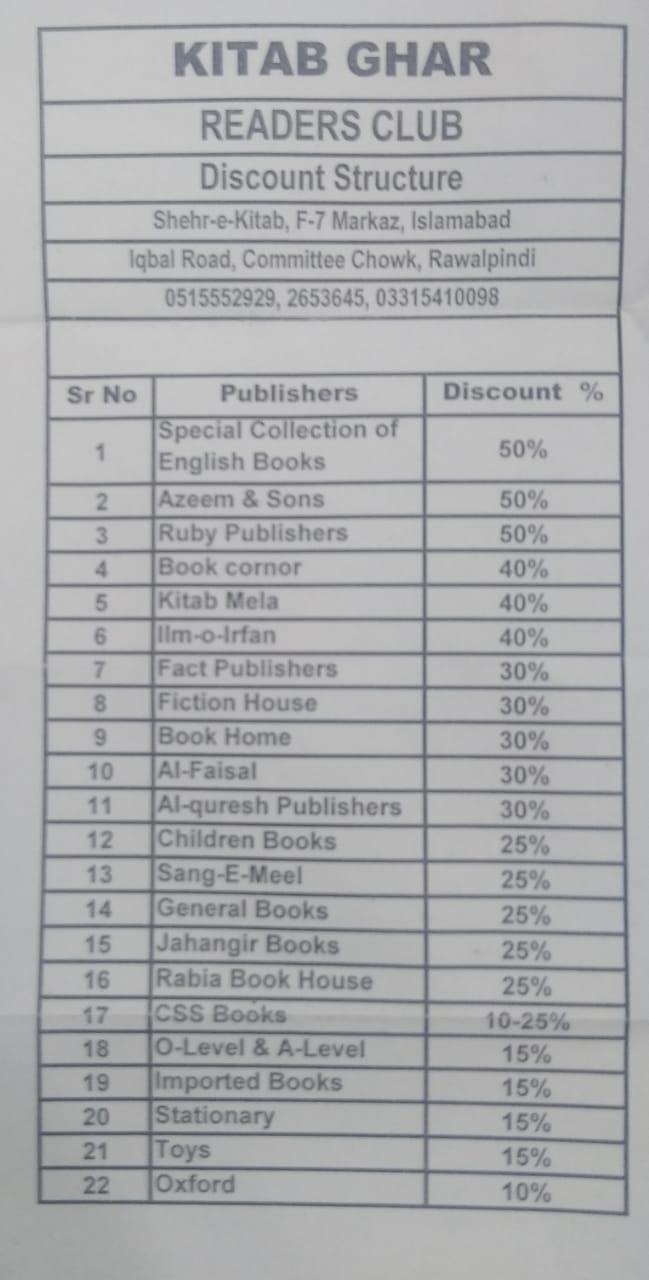
incentive to book-readers to avail 50% rebate on purchase of books for a year
time and that too for unlimited buying on a meagre membership fee of Rs: 500-
that will instantly consumed on 50% discount of customers’ first visit at both
outlets of Kitaab Ghar- at Committee Chowk, Rawalpindi and Jinnah Super Market
(F-7 Markaz), Islamabad”- a first of its kind from a private entity.
MAHTAB BASHIR
0333-53 63 248
mahtabbashir@gmail.com
ISLAMABAD
 |
"An hour spent reading is one stolen from Paradise."
|
The dedication and hard work of
pioneering publishers, scholars, and book lovers have not come to fruition yet
in Pakistan. Publishers have been demanding for decades for book publishing to
be recognized as an industry. Despite repeated promises, the government has not
taken any steps to materialize this demand.
Sitting in his bookstore named
‘Kitaab Ghar’ at Jinnah Super Market (F-7 Markaz), Khalid Masood says it is
very unfortunate to see book-reading culture is on the decline in Pakistan.
“It gives me pain to see that the
habit of reading has been declining among our younger generation. While
technology is steadily taking control over individual lives, we must find a way
to encourage our children to read. Books are also costly, which is a
contributing factor to the situation. Some parents discourage children from
reading for pleasure and force them to read textbooks only,” Khalid says adding
book reading is a contagious habit- if parents are away from books- their
children are least bother to read books.
Also, the publisher opines, “The
overuse of technology should be discouraged. The government should set up at
least one library in every sector of Islamabad. Students should be encouraged
to read books besides textbooks by teachers at school, college and university
levels and by parents,” Khalid suggests.
 |
Khalid Masood- Owner Kitaab Ghar
|
He said for the first time ever
in the history of Pakistan, ‘Kitaab Ghar’ has taken this initiative to entice
book-lovers through its ‘Readers Club Scheme’- under which we are providing 50%
rebate on purchase of books of all genre annually without limit with the
membership fee of Rs.500/=
Khalid Masood maintains that
membership card is valid on both outlets of ‘Kitaab Ghar’ of F-7 Markaz (Jinnah
Super Market) and Committee Chowk, Rawalpindi.
Khalid Masood, the CEO of ‘Kitaab
Ghar’ narrates that, “Of course, interest is a matter of concern. Your
disinterest might work to deter the child from the books. A good practice here
is to mix and match varieties of stories, including topics you like. Reading
and creating conversation about a book is a key skill which you can easily
impart to your child.”
You wonder at times about the
state of reading in the world you are part of. There is the sense that it is
dying, that indeed these increasing levels of sophistication coming into
technology are in essence putting holes into our old habits of reading. Not
many people read today, which is a pity. Worse is the knowledge that bookstores
are being downsized because business is not good. And what you have in place of
these truncated, eventually murdered bookstores is storehouses of all those
things that reflect the decline of intellect in our times.
 |
Khalid Masood with his father Malik Ghulam Muhammad
|
Khalid describes that one of the
positive changes brought about by the pandemic is the culture of online
activities. “Not only did social media communities on Instagram and Facebook
burst open with possibilities, seeing increasingly more book reviews,
giveaways, and nation-wide book exchanges organised by readers themselves, but
publishers and booksellers, too, adapted a regular practice of holding virtual
book launches and discussions with authors.
On the other hand, question
remains the same: “How many programmes are there on that ubiquity of television
channels that cater to books, to reading? There are nations that are privy to
book discussions on television, to authors talking about their works. Surely
similar discussions for an hour or so every week can be injected into the
television schedules in Pakistan.
There are newspapers, Urdu as
well as English, which come up with weekly reviews of books. It would not be a
bad idea calling in reviewers and bringing them in touch with readers through
the medium of television and radio. There are rivers that nourish the land. And
books nurture the soul, he keeps talking.
Telling a tale of his laborious
father, Malik Ghulam Muhammad, Khalid Masood narrates: his father established
‘Kitaab Ghar’ in 1948 at Committee Chowk, Rawalpindi for the promotion of book
and book-reading. After awhile, he started publishing books. He started
publishing ‘novels’ of prominent Urdu and English writers. In 1964, he took the
initiative for publication of a digest with the name of ‘Kamran Series’ with
similar features of ‘Imran Series’- after publicity of Imran Digest, a mushroom
growth of such publications took place in Lahore and Karachi.
Since then, Khalid says, he was
head over heal in love with book-reading and publishing and indulged in this
profession with his father- who died in 2012 at the age of 94. “Now is the time
to think about qualitative development. We need to ensure excellence in book
writing and publishing. And to do so, readership has to be developed in every
part, in every institution of our society,” he says adding to keep publishing
sector alive, we really need to bring in meritorious young entrepreneurs in
this sector and for doing so, the government should recognize it as an
industry.
 |
With his kids Ali Masood & Hassan Masood
|
He requested National Book
Foundation (NBF) high-up’s to to take effective measures to in promotion of
book-reading through ‘Shehar-e-Kitaab’ situated in F-7 Markaz and to use its
own property more efficiently.
The World Culture Score Index
conducted a global study to measure the amount of time that people around the
world spend reading on a weekly basis. The results of this study do not specify
what type of material is being read, which could be anything from online news
to work e-mails and magazines to books in print. Additionally, the study does
not report specific information about the people surveyed (like age,
educational level, or sex) or how many people were surveyed.
https://www.worldatlas.com/articles/the-countries-that-read-the-most.html
India topped the list with its
citizens reporting an average of 10 hours and 42 minutes a week spent reading.
Achieving the number 1 position on the list is quite an accomplishment for this
country, which has a literacy rate that is lower than the global average (only
74%). This rate has, however, increased by more than 6 times since the country
gained its independence in 1947, which could be an indicator of an increasing
interest in reading. This time spent reading does not necessarily reflect the
amount of time reading printed books, however, and may include time spent
reading online or in electronic format.*
.jpeg)

.jpeg)
.jpeg)