Friday, October 10, 2014

PLEASE MR. POSTMAN ...

World Post Day: remembering where it all started from

MAHTAB BASHIR
ISLAMABAD

'Stop! Oh yes, wait a minute, Mr. Postman, Wait, Wait Mr. Postman, Please Mr. Postman look and see, If there's a letter in your bag for me, Why's it takin' such a long time, For me to hear from that boy of mine. There must be some word today, From my boyfriend, So far away, Please Mr. Postman Look and see, If there's a letter, A letter for me'. Many of us have heard this classic hit song of 1960's from Marvelettes pleading postman to deliver letter from her beloved.

With the same urge of Marvelettes, World Post Day is going to be observed throughout the world including Pakistan today (Thursday) to create and maintain a structure for the free flow of international mail around the world.

World Post Day is celebrated every year on October 9 and it commemorates founding of the Universal Postal Union (UPU) in 1874 in Bern, Switzerland Capital.

Today, across the world, post offices are celebrating this special day in many different ways. This includes special philatelic exhibitions, free entrance in postal museums, introducing new products and services, seminars, workshops and more.

From the earliest times in history, 'postal services' existed in the form of messengers who travelled large distances on foot or horseback. In the 1600s and 1700s, many countries set up national postage systems and entered into bilateral agreements for the exchange of mail between countries.

By late 1800s, there was a large web of bilateral agreements that made distribution of international mail complicated, nontransparent and inefficient.

In 1863, Montgomery Blair, Postmaster General in the United States of America, organized a conference of representatives from 15 European and American countries.

During this conference, delegates laid down a number of general principles for mutual agreements on international postal services but did not create an international postal agreement.

On September 15, 1874, Heinrich von Stephan, a senior postal official in the North German Confederation (an area that now forms parts of Germany, Poland and Russia), opened a conference in Berne, Switzerland, with delegates from 22 countries.

On October 9, 1874, the delegates signed the Treaty of Berne and established the General Postal Union.

Number of countries that were members of the General Postal Union grew rapidly and the union's name was changed to the Universal Postal Union in 1878.

In 1948, the Universal Postal Union became a specialized agency of the United Nations. The 16th Universal Postal Union Congress was held in Tokyo, Japan, from October 1 to November 16, 1969. During this conference the delegates voted to declare October 9 each year as World Post Day.

Postal Staff College: On the day, various organizations will hold functions at Postal Staff Collage, G-8/4 Islamabad, to celebrate the World Post Day, where Senior Postal Executives and heads of other departments will participate.  

Other activities that will take places include presentation of Universal Postal Union (UPU) documentary, reading out message of D.G. UPU presentations, songs by a group school children, acting play of selected song containing the theme of UPU written by Additional Director General (Operational) Fazli Sattar Khan.

The ministry will also distribute aid packets among flood-affected postal employees in different parts of the country. Musical performance by Ustad Raees Ahmad Khan & group, speech by chief guest and also presentation of souvenirs to Turkish ambassador and chief guest by the chairman Abdul Hameed will be hallmarks of the ceremony.

So, go out, buy some postcards or some nice letter paper and write to all your friends and family; remind them that the post is a very important part of our lives. Happy World Post Day!

Also published in Daily Times

http://archives.dailytimes.com.pk/islamabad/09-Oct-2010/please-mr-postman

Friday, September 19, 2014

SCOTLAND VOTES TO STAY IN THE UK

Only four Scottish constituencies voted in favor of seceding from the U.K.

Scotland rejected independence in Friday’s referendum count, with around 55% of voters choosing to stay within the U.K. The 307-year-strong union has survived, although increased powers will be devolved to the nation.

Scottish First Minister Alex Salmond, who spearheaded the Yes campaign, conceded defeat at around 6:17 a.m. local time. “On behalf of the Scottish government I accept the result and pledge to work constructively in the interests of Scotland and the rest of the United Kingdom,” he said.

“The process by which we have made our decision as a nation reflects enormous credit upon Scotland. A turnout of 86% is one of the highest in the democratic world for any election or referendum in history — this has been a triumph for the democratic process and participation in politics.”

Despite a hard-fought campaign, only four of the 32 local authority districts voted for independence, including populous Glasgow, although even in this key constituency the margin was not particularly large, in a devastating blow to the Yes camp.

The final bell tolled for secession advocates after Edinburgh voted to maintain ties with the south by 61%.

“I am delighted,” said British Prime Minister David Cameron, hinting that more devolved powers would also be rolled out to other British regions. “It would have broken my heart to see the United Kingdom come to the end.”

Alistair Darling, the former Chancellor of the Exchequer who led the No campaign, admitted that the closeness of the result was a wake-up call.

“Today is a momentous today for Scotland and the United Kingdom as a whole,” he said. “While confirming our place within the union, we have confirmed the bonds that tie us together — may they never be broken.”

Pubs across the country were staying open throughout the night with customers both anxious and excited to see whether the historic union would be consigned to the history books.

Greg Waddell, a doctor working in Glasgow, told TIME that he voted Yes “because disempowerment breeds dependency; because the current extent of social inequality in Scotland demeans every one of its people.”

Others among the 4.2 million registered voters were less optimistic about prospects for going it alone. Nick Allan, an oil executive from Aberdeen, said the Yes campaign promises were enticing, but he voted No as it would be impossible to pay for them — especially not with North Sea oil.

“The problem comes down to money,” he says. “How on God’s earth are you going to be able to afford all of these improvements? The country will be bankrupt in a matter of years.”

Many questions regarding what a truly independent Scotland would look like remained unanswered, including over currency, health care, defense and E.U. membership. Spain’s Prime Minister was one of several European leaders who said he would not support Scotland’s application to the bloc, as the Iberian nation was unwilling to fan separatist campaigns of its own.

These fears were echoed by Professor Michael Desch, an expert on foreign policy at the Notre Dame University.

“Ironically, a peaceful Scottish secession from the United Kingdom could open Pandora’s Box by raising unrealistic expectations about the ease of parting long-established national ways,” he said.

The vote captivated social media. Over the past 24 hours, 1.3 million people on Facebook made 3.3 million interactions regarding the Scottish referendum debate.
Courtesy: time.com

Monday, September 15, 2014

A LONE WOLF PACES THE STAGE

Courtesy Kashif Abbasi 

On Thursday afternoon, as party leaders announced the Pakistan Tehreek-i-Insaf’s decision to suspend talks with the government, a lonely wolf paced the roof of his container on Constitution Avenue.

Under the glare of the afternoon sun, Imran Khan was all but alone atop his stage – save for a few other party hands. But before him were not the multitudes that he had grown accustomed to.

In fact, around 2pm, dozens of empty chairs stared back at the PTI chief as he grabbed the mic to try and rouse the spirits of those who were in attendance.

Mr Khan was obviously perturbed, his mind no doubt preoccupied by the politicking that he and his party leaders were involved in.

But as he paced back and forth in clear view of TV cameras, those in attendance betrayed a sense of concern – even if for a brief while.

But as time passed and he began to speak to the crowd, morale among those in attendance improved. More people began to arrive by the late afternoon and the mood in the crowd as well as atop the container began to improve.

“I think our leader is worried about our party workers following reports that the government is set to launch a crackdown against them,” said Mohammad Hashim, who came all the way from Sargodha to hear his leader speak.

Another PTI supporter, Irfan Ahmed, appeared confused, saying it looked like something might happen because the main leadership, including Shah Mehmood Qureshi, Javed Hashmi, Asad Umar and Jahangir Tareen were missing from the stage.

But at the time, these leaders were addressing a press conference, where they announced the conditional suspension of the ongoing dialogue with the government committee.

“My cousin, a constable in the Punjab police, is deployed here on special duty. He told me a few minutes ago that the government is mulling a crackdown… so I think the chairman is thinking about some way to counter this,” said Mardan-resident Niaz Ahmed.

But things improved drastically by the early evening, as Islamabad residents, who had left the venue to freshen up, began to return in droves. In the interim, Mr Khan’s fiery anti-government rhetoric and the rousing beats of DJ Butt kept workers’ morale high. Indeed, hundreds of workers could be seen dancing to the tunes of revolution, particularly the Pashto anthem ‘Waya Waya’.

“There is no need to be tense. It is commonplace for our workers to join the sit-in after sunset. You will see, in the evening thousands will join us,” said another party worker Abdullah Ahmed.

Published in Dawn, August 22nd, 2014

Tuesday, September 9, 2014

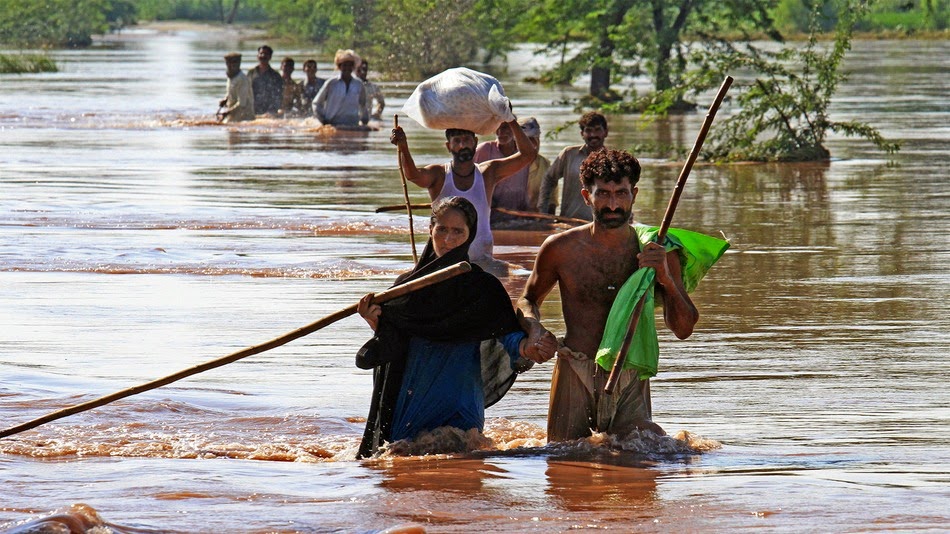
NOTHING CHANGED WITH THE RAINS

Looking at the pictures of inundated streets, flooded roads and overflowing drains, one could be forgiven for thinking that this is the first time monsoon rains have unleashed themselves on the province of Punjab. But that would be fooling no one but ourselves. The whole country deals with monsoon rains every year, sometimes in buckets and sometimes in spades. This year, the rainy season has arrived late, but now it has come with a vengeance.

The fact that the provincial government and our disaster management agencies have been caught with their pants down once again is not just embarrassing, it is costing lives. So far, the death toll has reached more than 80. The causes of death include roof collapses, landslides and electrocution. All of these fatalities can be attributed to negligence and an extreme lack of preparedness to tackle a problem that afflicts us each year. Lahore is hardly recognisable: knee high water, homes flooded with rain and gutter filth and vehicles stranded in deep pools. Work, commute, daily activities have all come to a halt because the administration and the disaster management authorities have been lazing about all year refusing to prepare for what we all knew was likely to come. Weather reports state that the downpour will continue for the next few days, perhaps even intensifying in nature. This spells catastrophe for a majority of the people living in shanty homes and the presence of poor quality infrastructure will ensure that more tragic deaths follow.
 
In low-lying areas such as our main cities in Punjab, the monsoon rains are particularly harsh. The poor, ancient drainage system cannot handle the deluge and overflows within minutes, resulting in filthy standing water. No one has bothered to fix or replace this faulty system over the years and, to add insult to injury, no one has even tried to extend any measures to limit the damage by improving the quality of construction in poorer areas of the cities. Every year people with limited resources suffer the rains while those more fortunate celebrate the onset of the monsoon.

However, not many are celebrating this year as even Azad Kashmir is registering record highs in rainfall and is facing landslides. Some 80 villages near Sialkot have been evacuated due to flash flood warnings. Reports suggest that as much as 0.9 million cusecs of water have entered Pakistan through the Indus, Jhelum and Chenab. The National Disaster Management Authority (NDMA) has issued flood warnings and that is all. The Water and Sanitation Authority (WASA) stands helpless in oceans of deluge, not knowing where to even begin any relief efforts. It is of little surprise then that the army has been called in to help relocate evacuated families (once again).
 
The flash floods of 2010 submerged one fifth of the country in water and displaced millions of people. We still have internally displaced persons (IDPs) from that catastrophe languishing without shelter and rehabilitation. Subsequent floods and monsoon rains have added to the IDP count and infrastructure damage with nothing done to lessen the hardships of the masses. This is the pathetic state of a country that should be well equipped by now to deal with the calamity of expected rainfall but our only form of management seems to be to mutely move from one disaster to the next, praying that the worst will soon be over. Concrete steps need to be taken to improve construction, the state of how people live, the drainage and sanitation and an early warning system designed to alert the public to impending disasters. We may not be able to entirely alleviate the impact of Mother Nature, but we can at least try to lessen the tragedy and destruction as much as humanly possible.


Courtesy: Daily Times

Monday, September 1, 2014

OUR DARKEST HOUR

Saturday night (August 30, 2014) was a dark time in Pakistan’s history. Spurred on by Tahirul Qadri and Imran Khan, workers from the Pakistan Awami Tehreek (PAT) and Pakistan Teheek-e-Insaaf (PTI) formed a mob and attacked the Prime Minister’s (PM’s) House and the fenced compound that encloses the houses of parliament and the presidency. Veteran human rights campaigner Asma Jehangir, whose moral stature towers above these two riot instigators, had it right when she told a local television channel: “There is no such thing as peaceful banditry.” Imran Khan and Tahirul Qadri, despite their numerous claims of wanting peaceful protest, engaged instead in one of the most disgusting spectacles of mob violence this country has had the misfortune of seeing.

Saturday night’s events have already become obscured by controversy, but the sequence of events shows precisely where responsibility lies for the injuries and deaths among rioters and the police, and the destruction of public property. After presenting yet another deadline to the government for the PM’s resignation, Tahirul Qadri led from behind and ordered his workers to march towards the PM’s House while he sat in his car. Imran Khan had previously said he would not join in the invasion, making promises to the government and the military that these areas would remain sacrosanct. However, at the last minute, and reportedly against the majority consensus in his party, he decided to join his workers to Tahirul Qadri’s. They also told their workers to begin protests in other cities. The combined mob began to press towards the PM’s residence, but diverted and began leaping over and breaking the gates and fences surrounding parliament and the presidency.
 
After the police retreated literally to the doors of the presidency, this was the line drawn in the sand that the government could not ignore and when the mob turned towards the buildings, the police were forced to teargas them and drive them off the premises. The mob responded by attacking the police, using batons and rocks and the situation soon devolved into a full scale riot on the presidency grounds. Reportedly the protestors tried to force their way into the National Assembly (NA) but retreated when they saw the doors were guarded by army and Rangers personnel. No doubt they were told by their leadership not to engage the military. However, engaging the police was more than enough to turn the parliament grounds and Constitution Avenue into a veritable warzone, with rioters bent on causing destruction after being left with no clear goal in mind. In Lahore a mob assembled at Liberty Roundabout and began trashing storefronts and looting.

The riot in Islamabad lasted well into the morning though by then the mob of several thousand had dwindled to several hundreds. Three people were killed and hundreds injured, some by rubber bullets but most from exposure to teargas. Through it all Imran Khan was visible on top of his container, loudspeaker in hand, exhorting workers to charge the police, fight, and attack parliament. It was a sight so putrid that it beggars belief he has the gall to stand in front of the Pakistani nation again today and claim he is the victim. Apparently this realisation is dawning on PTI leaders too. Javed Hashmi and Shah Mehmood Qureshi were reportedly against the decision to join the riot and have not appeared beside Imran Khan since. After calling for a joint session of parliament for Tuesday, it is hoped that the government can quell the riots and bring the perpetrators to justice after imposing Section 144 in Islamabad, which prohibits large public gatherings, but one cannot rule out the possibility that fresh elections become inevitable, despite the PM’s legal mandate.

The country is now poised on the brink of an uncertain future and the situation is grave enough that COAS General Raheel Shareef moved up a corps commanders meeting to Sunday evening to discuss it. He must order the army to do its duty and protect the official residence of its commander-in-chief. With another battle in Islamabad looming, the next 24 hours may decide the future of this country.


Courtesy: Daily Times

Tuesday, August 19, 2014

PTI’s DESPERATE GAMBLE- WHEN "LONG MARCH" TURNS INTO "WRONG MARCH"

The Pakistan Tehreek-e-Insaaf’s (PTI) ‘Independence March’ began with a call for the government to resign. It ends with the PTI saying it will resign instead from the National Assembly (NA) and all provincial assemblies except Khyber Pakhtunkhwa (KP), though both decisions are still under debate. Flanked by a worried looking KP Chief Minister (CM) who undoubtedly sees a hard won election victory going down the drain, Imran Khan made the announcement in Islamabad yesterday and said he and his supporters will enter the Red Zone where sensitive government installations are located, despite having given written assurances to the authorities that he would not do so. What this desperate measure is meant to achieve appears to be nothing more than saving Imran the embarrassment of having to back down and admit his march failed to gather the critical mass of people necessary to appear as a legitimate popular movement.

If the PTI does resign the government will have to hold by-elections, where the PTI will probably lose seats if it contests. This could lead to dissent within the party if legislators have to reinvest in campaigning so soon after victory because of their leader’s short-sighted electoral politics. In KP, despite forming the government, the PTI does not have a majority of seats, meaning that if it resigns, unless the CM dissolves the assembly there is a precedent for a minority government that could reign in the interim until by-elections fill the remaining seats. The announcement follows Imran Khan’s garbled call for ‘civil disobedience’ on Sunday, which consists of his supporters refusing to pay bills and taxes. This should not inconvenience the government since it can cut electricity to defaulters, confiscate assets, and punish tax evaders under the relevant laws. It is also difficult to imagine several thousand charged party workers facing off against several thousand policemen in Islamabad’s most sensitive area, the Red Zone, without violence, in spite of his declaration. Since Imran has descended into delusion, the government must ensure restraint in what is a potentially combustible environment.

The government put Islamabad on red alert following the announcement, and the worry is that if ‘civil disobedience’ or marching on the Red Zone leads to clashes, bloodshed and arrests, the country could descend into further anarchy. With terrorism rampant, security is a prime concern and the government has a legitimate worry about letting thousands of people into the country’s nerve-centre. Moreover, a march into the Red Zone achieves nothing aside from a symbolic partial victory. Is it worth losing a strong presence in the NA and the provincial Assemblies? From the perspective of electoral politics, no it is not.

From a populist perspective, Imran is playing the only card he has left. This is not the stuff of revolutions; even the Kiev ‘Maidan’, a similar putsch to Imran’s attempt, had as many as 150,000 people in a country with a much smaller population. This should tell Imran two things; first, his popularity is not as widespread and unflinching as he assumed, which casts doubt on his claim that the 2013 elections were rigged. Second, his protest caused a great deal of uncertainty and upset for ordinary citizens who want nothing more than a few years of stability in which to reorder their lives. It has made him deeply unpopular with many of his former supporters. If anything, it may have strengthened the government, which now has every major political party on its side and appears relatively sane by comparison, its past sins of omission and commission notwithstanding. It repeatedly offered Imran a way out and is still doing so, setting up multi-party committees to negotiate with the PTI and PAT.
Iman Khan now has three options: he can turn to violence, he can negotiate, or his party can resign and fade into obscurity. Nawaz Sharif has given no indication he will resign, and Imran’s best hope of leaving this debacle behind is to accept the government’s peace offering and push his remaining demands at the negotiating table. If his party follows through with the threat to resign, he will be the only loser.  

Courtesy Daily Times

Saturday, August 2, 2014

MAJID NIZAMI: END OF A JOURNALISTIC ERA

Majid Nizami and my father Bashir Hussain Nazim had not only enjoyed unconditional friendship spanning over four and a half decade but also had a similar personal traits, i-e love for motherland, ideology of Pakistan, philosophy of Iqbal, political sagacity of Quaid and last but surely not the least their resistance against dictatorial regimes. 
P.S: Both left this mortal world on sacred days of Islamic calendar. Bashir Hussain Nazim was laid to rest on 27th Rajab (Shab-e-Meraj) June 17, 2012 while Majid Nizami was handed over to his maker on 27th Ramadan (July 26, 2014).   

With the passing away of Dr. Majid Nizami, chief of the Nawa-i-Waqt group of publications, has come to end an important era in Pakistan's history of journalism. Majid Sahib, as he was popularly known, took over the paper after the demise of his elder brother, Hameed Nizami, founder of Nawa-i-Waqt and a pioneer of independent journalism in this country.

In his professional career spanning well over half a century, Dr Nizami made a name for himself as a highly-respected editor. This did not come easy in a country where press has always been under pressure from military rulers, even civilian governments. True to a quotation his paper carried each day on its masthead "telling the truth to an oppressive ruler is jihad", he never hesitated to speak truth to power.

Unlike many in the profession who change colour with the changing times out of self-interest, Nizami always firmly stood by his convictions. Throughout his life he remained an ardent advocate of the 'Ideology of Pakistan', and helped found the Nazria-i-Pakistan Trust, an institution dedicated to the promotion and projection of the "Ideology of Pakistan as enunciated by Quaid-i-Azam Mohammad Ali Jinnah and Allama Mohammad Iqbal."

Equally zealously he supported the Kashmir cause, and argued for continuation of a confrontational policy towards India. He was also a strong proponent of a nuclear Pakistan. When it came to issues pertaining to India he could be the most hawkish of hawks. He was as uncompromising on the question of normalisation with India without resolution of Kashmir as he was on what he called 'slavery of military overlordship'. Clearly, on the former score, Majid Nizami was out of tune with the times.

Quoting an incident while fixing my date of wedding in the month of April (2012), my father (Bashir Hussain Nazim) straightaway shifted the date of April 21 to April 28 because of an annual function held under the aegis of Nazria Pakistan Trust where he had been reciting Kalam-e-Iqbal for the last 40 years. In this regard he was conferred upon “Iqbal Gold Medal” at Lahore in a ceremony.    

Strong views elicit strong reactions. Not only did Majid Nizami Sahib have a loyal following in some sections of society, he was arguably revered by country's military establishment. But he also had many critics because of his views on the controversial 'ideology of Pakistan' and a belligerent stance on India. To give him his due, he practiced what he believed in. Even though there are few takers left of his views on India, he stuck to them. The consistency with which he dealt with various other national issues and concerns commanded respect. He will long be remembered for the contribution he made to the cause of democracy as editor of a popular Urdu daily.

Majid Nizami will be missed as an upright editor who always wrote and said the right thing under the most trying circumstances. He will be remembered for his legacy of high standards of journalism and proprietorship. May his soul should rest in eternal peace.

DARE-RC SUMMIT CALLS FOR EVIDENCE-LED TRANSFORMATION IN PAKISTAN’S EDUCATION

The two-day DARE-RC International Education Summit stressed that data, research, and classroom realities must guide education policy in Paki...