Monday, September 15, 2014

A LONE WOLF PACES THE STAGE

Courtesy Kashif Abbasi 

On Thursday afternoon, as party leaders announced the Pakistan Tehreek-i-Insaf’s decision to suspend talks with the government, a lonely wolf paced the roof of his container on Constitution Avenue.

Under the glare of the afternoon sun, Imran Khan was all but alone atop his stage – save for a few other party hands. But before him were not the multitudes that he had grown accustomed to.

In fact, around 2pm, dozens of empty chairs stared back at the PTI chief as he grabbed the mic to try and rouse the spirits of those who were in attendance.

Mr Khan was obviously perturbed, his mind no doubt preoccupied by the politicking that he and his party leaders were involved in.

But as he paced back and forth in clear view of TV cameras, those in attendance betrayed a sense of concern – even if for a brief while.

But as time passed and he began to speak to the crowd, morale among those in attendance improved. More people began to arrive by the late afternoon and the mood in the crowd as well as atop the container began to improve.

“I think our leader is worried about our party workers following reports that the government is set to launch a crackdown against them,” said Mohammad Hashim, who came all the way from Sargodha to hear his leader speak.

Another PTI supporter, Irfan Ahmed, appeared confused, saying it looked like something might happen because the main leadership, including Shah Mehmood Qureshi, Javed Hashmi, Asad Umar and Jahangir Tareen were missing from the stage.

But at the time, these leaders were addressing a press conference, where they announced the conditional suspension of the ongoing dialogue with the government committee.

“My cousin, a constable in the Punjab police, is deployed here on special duty. He told me a few minutes ago that the government is mulling a crackdown… so I think the chairman is thinking about some way to counter this,” said Mardan-resident Niaz Ahmed.

But things improved drastically by the early evening, as Islamabad residents, who had left the venue to freshen up, began to return in droves. In the interim, Mr Khan’s fiery anti-government rhetoric and the rousing beats of DJ Butt kept workers’ morale high. Indeed, hundreds of workers could be seen dancing to the tunes of revolution, particularly the Pashto anthem ‘Waya Waya’.

“There is no need to be tense. It is commonplace for our workers to join the sit-in after sunset. You will see, in the evening thousands will join us,” said another party worker Abdullah Ahmed.

Published in Dawn, August 22nd, 2014

Tuesday, September 9, 2014

NOTHING CHANGED WITH THE RAINS

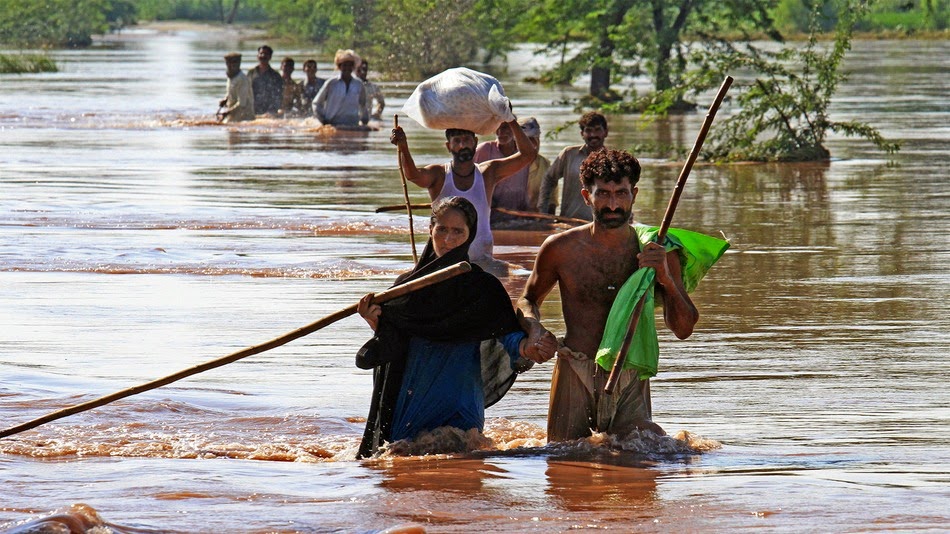
Looking at the pictures of inundated streets, flooded roads and overflowing drains, one could be forgiven for thinking that this is the first time monsoon rains have unleashed themselves on the province of Punjab. But that would be fooling no one but ourselves. The whole country deals with monsoon rains every year, sometimes in buckets and sometimes in spades. This year, the rainy season has arrived late, but now it has come with a vengeance.

The fact that the provincial government and our disaster management agencies have been caught with their pants down once again is not just embarrassing, it is costing lives. So far, the death toll has reached more than 80. The causes of death include roof collapses, landslides and electrocution. All of these fatalities can be attributed to negligence and an extreme lack of preparedness to tackle a problem that afflicts us each year. Lahore is hardly recognisable: knee high water, homes flooded with rain and gutter filth and vehicles stranded in deep pools. Work, commute, daily activities have all come to a halt because the administration and the disaster management authorities have been lazing about all year refusing to prepare for what we all knew was likely to come. Weather reports state that the downpour will continue for the next few days, perhaps even intensifying in nature. This spells catastrophe for a majority of the people living in shanty homes and the presence of poor quality infrastructure will ensure that more tragic deaths follow.
 
In low-lying areas such as our main cities in Punjab, the monsoon rains are particularly harsh. The poor, ancient drainage system cannot handle the deluge and overflows within minutes, resulting in filthy standing water. No one has bothered to fix or replace this faulty system over the years and, to add insult to injury, no one has even tried to extend any measures to limit the damage by improving the quality of construction in poorer areas of the cities. Every year people with limited resources suffer the rains while those more fortunate celebrate the onset of the monsoon.

However, not many are celebrating this year as even Azad Kashmir is registering record highs in rainfall and is facing landslides. Some 80 villages near Sialkot have been evacuated due to flash flood warnings. Reports suggest that as much as 0.9 million cusecs of water have entered Pakistan through the Indus, Jhelum and Chenab. The National Disaster Management Authority (NDMA) has issued flood warnings and that is all. The Water and Sanitation Authority (WASA) stands helpless in oceans of deluge, not knowing where to even begin any relief efforts. It is of little surprise then that the army has been called in to help relocate evacuated families (once again).
 
The flash floods of 2010 submerged one fifth of the country in water and displaced millions of people. We still have internally displaced persons (IDPs) from that catastrophe languishing without shelter and rehabilitation. Subsequent floods and monsoon rains have added to the IDP count and infrastructure damage with nothing done to lessen the hardships of the masses. This is the pathetic state of a country that should be well equipped by now to deal with the calamity of expected rainfall but our only form of management seems to be to mutely move from one disaster to the next, praying that the worst will soon be over. Concrete steps need to be taken to improve construction, the state of how people live, the drainage and sanitation and an early warning system designed to alert the public to impending disasters. We may not be able to entirely alleviate the impact of Mother Nature, but we can at least try to lessen the tragedy and destruction as much as humanly possible.


Courtesy: Daily Times

Monday, September 1, 2014

OUR DARKEST HOUR

Saturday night (August 30, 2014) was a dark time in Pakistan’s history. Spurred on by Tahirul Qadri and Imran Khan, workers from the Pakistan Awami Tehreek (PAT) and Pakistan Teheek-e-Insaaf (PTI) formed a mob and attacked the Prime Minister’s (PM’s) House and the fenced compound that encloses the houses of parliament and the presidency. Veteran human rights campaigner Asma Jehangir, whose moral stature towers above these two riot instigators, had it right when she told a local television channel: “There is no such thing as peaceful banditry.” Imran Khan and Tahirul Qadri, despite their numerous claims of wanting peaceful protest, engaged instead in one of the most disgusting spectacles of mob violence this country has had the misfortune of seeing.

Saturday night’s events have already become obscured by controversy, but the sequence of events shows precisely where responsibility lies for the injuries and deaths among rioters and the police, and the destruction of public property. After presenting yet another deadline to the government for the PM’s resignation, Tahirul Qadri led from behind and ordered his workers to march towards the PM’s House while he sat in his car. Imran Khan had previously said he would not join in the invasion, making promises to the government and the military that these areas would remain sacrosanct. However, at the last minute, and reportedly against the majority consensus in his party, he decided to join his workers to Tahirul Qadri’s. They also told their workers to begin protests in other cities. The combined mob began to press towards the PM’s residence, but diverted and began leaping over and breaking the gates and fences surrounding parliament and the presidency.
 
After the police retreated literally to the doors of the presidency, this was the line drawn in the sand that the government could not ignore and when the mob turned towards the buildings, the police were forced to teargas them and drive them off the premises. The mob responded by attacking the police, using batons and rocks and the situation soon devolved into a full scale riot on the presidency grounds. Reportedly the protestors tried to force their way into the National Assembly (NA) but retreated when they saw the doors were guarded by army and Rangers personnel. No doubt they were told by their leadership not to engage the military. However, engaging the police was more than enough to turn the parliament grounds and Constitution Avenue into a veritable warzone, with rioters bent on causing destruction after being left with no clear goal in mind. In Lahore a mob assembled at Liberty Roundabout and began trashing storefronts and looting.

The riot in Islamabad lasted well into the morning though by then the mob of several thousand had dwindled to several hundreds. Three people were killed and hundreds injured, some by rubber bullets but most from exposure to teargas. Through it all Imran Khan was visible on top of his container, loudspeaker in hand, exhorting workers to charge the police, fight, and attack parliament. It was a sight so putrid that it beggars belief he has the gall to stand in front of the Pakistani nation again today and claim he is the victim. Apparently this realisation is dawning on PTI leaders too. Javed Hashmi and Shah Mehmood Qureshi were reportedly against the decision to join the riot and have not appeared beside Imran Khan since. After calling for a joint session of parliament for Tuesday, it is hoped that the government can quell the riots and bring the perpetrators to justice after imposing Section 144 in Islamabad, which prohibits large public gatherings, but one cannot rule out the possibility that fresh elections become inevitable, despite the PM’s legal mandate.

The country is now poised on the brink of an uncertain future and the situation is grave enough that COAS General Raheel Shareef moved up a corps commanders meeting to Sunday evening to discuss it. He must order the army to do its duty and protect the official residence of its commander-in-chief. With another battle in Islamabad looming, the next 24 hours may decide the future of this country.


Courtesy: Daily Times

Tuesday, August 19, 2014

PTI’s DESPERATE GAMBLE- WHEN "LONG MARCH" TURNS INTO "WRONG MARCH"

The Pakistan Tehreek-e-Insaaf’s (PTI) ‘Independence March’ began with a call for the government to resign. It ends with the PTI saying it will resign instead from the National Assembly (NA) and all provincial assemblies except Khyber Pakhtunkhwa (KP), though both decisions are still under debate. Flanked by a worried looking KP Chief Minister (CM) who undoubtedly sees a hard won election victory going down the drain, Imran Khan made the announcement in Islamabad yesterday and said he and his supporters will enter the Red Zone where sensitive government installations are located, despite having given written assurances to the authorities that he would not do so. What this desperate measure is meant to achieve appears to be nothing more than saving Imran the embarrassment of having to back down and admit his march failed to gather the critical mass of people necessary to appear as a legitimate popular movement.

If the PTI does resign the government will have to hold by-elections, where the PTI will probably lose seats if it contests. This could lead to dissent within the party if legislators have to reinvest in campaigning so soon after victory because of their leader’s short-sighted electoral politics. In KP, despite forming the government, the PTI does not have a majority of seats, meaning that if it resigns, unless the CM dissolves the assembly there is a precedent for a minority government that could reign in the interim until by-elections fill the remaining seats. The announcement follows Imran Khan’s garbled call for ‘civil disobedience’ on Sunday, which consists of his supporters refusing to pay bills and taxes. This should not inconvenience the government since it can cut electricity to defaulters, confiscate assets, and punish tax evaders under the relevant laws. It is also difficult to imagine several thousand charged party workers facing off against several thousand policemen in Islamabad’s most sensitive area, the Red Zone, without violence, in spite of his declaration. Since Imran has descended into delusion, the government must ensure restraint in what is a potentially combustible environment.

The government put Islamabad on red alert following the announcement, and the worry is that if ‘civil disobedience’ or marching on the Red Zone leads to clashes, bloodshed and arrests, the country could descend into further anarchy. With terrorism rampant, security is a prime concern and the government has a legitimate worry about letting thousands of people into the country’s nerve-centre. Moreover, a march into the Red Zone achieves nothing aside from a symbolic partial victory. Is it worth losing a strong presence in the NA and the provincial Assemblies? From the perspective of electoral politics, no it is not.

From a populist perspective, Imran is playing the only card he has left. This is not the stuff of revolutions; even the Kiev ‘Maidan’, a similar putsch to Imran’s attempt, had as many as 150,000 people in a country with a much smaller population. This should tell Imran two things; first, his popularity is not as widespread and unflinching as he assumed, which casts doubt on his claim that the 2013 elections were rigged. Second, his protest caused a great deal of uncertainty and upset for ordinary citizens who want nothing more than a few years of stability in which to reorder their lives. It has made him deeply unpopular with many of his former supporters. If anything, it may have strengthened the government, which now has every major political party on its side and appears relatively sane by comparison, its past sins of omission and commission notwithstanding. It repeatedly offered Imran a way out and is still doing so, setting up multi-party committees to negotiate with the PTI and PAT.
Iman Khan now has three options: he can turn to violence, he can negotiate, or his party can resign and fade into obscurity. Nawaz Sharif has given no indication he will resign, and Imran’s best hope of leaving this debacle behind is to accept the government’s peace offering and push his remaining demands at the negotiating table. If his party follows through with the threat to resign, he will be the only loser.  

Courtesy Daily Times

Saturday, August 2, 2014

MAJID NIZAMI: END OF A JOURNALISTIC ERA

Majid Nizami and my father Bashir Hussain Nazim had not only enjoyed unconditional friendship spanning over four and a half decade but also had a similar personal traits, i-e love for motherland, ideology of Pakistan, philosophy of Iqbal, political sagacity of Quaid and last but surely not the least their resistance against dictatorial regimes. 
P.S: Both left this mortal world on sacred days of Islamic calendar. Bashir Hussain Nazim was laid to rest on 27th Rajab (Shab-e-Meraj) June 17, 2012 while Majid Nizami was handed over to his maker on 27th Ramadan (July 26, 2014).   

With the passing away of Dr. Majid Nizami, chief of the Nawa-i-Waqt group of publications, has come to end an important era in Pakistan's history of journalism. Majid Sahib, as he was popularly known, took over the paper after the demise of his elder brother, Hameed Nizami, founder of Nawa-i-Waqt and a pioneer of independent journalism in this country.

In his professional career spanning well over half a century, Dr Nizami made a name for himself as a highly-respected editor. This did not come easy in a country where press has always been under pressure from military rulers, even civilian governments. True to a quotation his paper carried each day on its masthead "telling the truth to an oppressive ruler is jihad", he never hesitated to speak truth to power.

Unlike many in the profession who change colour with the changing times out of self-interest, Nizami always firmly stood by his convictions. Throughout his life he remained an ardent advocate of the 'Ideology of Pakistan', and helped found the Nazria-i-Pakistan Trust, an institution dedicated to the promotion and projection of the "Ideology of Pakistan as enunciated by Quaid-i-Azam Mohammad Ali Jinnah and Allama Mohammad Iqbal."

Equally zealously he supported the Kashmir cause, and argued for continuation of a confrontational policy towards India. He was also a strong proponent of a nuclear Pakistan. When it came to issues pertaining to India he could be the most hawkish of hawks. He was as uncompromising on the question of normalisation with India without resolution of Kashmir as he was on what he called 'slavery of military overlordship'. Clearly, on the former score, Majid Nizami was out of tune with the times.

Quoting an incident while fixing my date of wedding in the month of April (2012), my father (Bashir Hussain Nazim) straightaway shifted the date of April 21 to April 28 because of an annual function held under the aegis of Nazria Pakistan Trust where he had been reciting Kalam-e-Iqbal for the last 40 years. In this regard he was conferred upon “Iqbal Gold Medal” at Lahore in a ceremony.    

Strong views elicit strong reactions. Not only did Majid Nizami Sahib have a loyal following in some sections of society, he was arguably revered by country's military establishment. But he also had many critics because of his views on the controversial 'ideology of Pakistan' and a belligerent stance on India. To give him his due, he practiced what he believed in. Even though there are few takers left of his views on India, he stuck to them. The consistency with which he dealt with various other national issues and concerns commanded respect. He will long be remembered for the contribution he made to the cause of democracy as editor of a popular Urdu daily.

Majid Nizami will be missed as an upright editor who always wrote and said the right thing under the most trying circumstances. He will be remembered for his legacy of high standards of journalism and proprietorship. May his soul should rest in eternal peace.

Wednesday, July 23, 2014

A SAFE ALTERNATIVE TO FEMALE CIRCUMCISION

Female circumcision, also called female genital mutilation (FGM) is widely practiced in at least 29 countries in Africa and the Middle East. More than 125 million women have been subjected to different forms of genital mutilation across Africa and in areas of western and southern Asia, and 2 million women undergo the procedure annually.

It is also carried out in Australia, Canada, England, France, and the United States among immigrants from countries where it is performed as a ritual. Female genital mutilation is internationally recognized as a violation of the human rights of girls and women. FGM has no health benefits to women. On the contrary, by removing normal, healthy genital tissue the procedure interferes with the body’s natural functions. A new rite to replace this practice offers hope to change this situation.

An alternative –and safe- rite to traditional female genital mutilation has been used for many years in some African countries. If more extensively used, it can contribute to put an end to a practice that has caused considerable harm and suffering to millions of women worldwide.

This new rite was initiated in the Tharaka district in Kenya in 1996, and grew out of the collaboration between a women’s Kenyan group, called “Maendeleo Ya Wanawake Organization” (MYWO) and the Program for Appropriate Technology in Health (PATH), a non-profit, international organization whose aim is to improve the health of women and children in developing countries.

The alternative rite initially practiced in Kenya is known as “ntanira na mugambo” or “circumcision through words.” Young women go through a week long program of counseling, training and education, capped by a day designated as the “coming of age day,” when members of the community join for a celebration with music, dances and feasting.

The rite consists of a week of seclusion. In it, the adolescents are taught basic concepts of anatomy and physiology, sexual and reproductive health and hygiene, and are counseled on gender issues, respect for adults, how to improve their self-esteem and how to deal with peer pressure.

The program recognizes the girls’ need for recognition, so they receive a certificate, presents, are granted special wishes and become the center of attention in the community during the final day of celebration. The mothers, many of whom act as peer educators, are then able to convert the fathers and the rest of the family.

A similar ritual, in which the girl is declared a woman without maiming her for life, is carried out in Uganda among the Sabiny tribe of farmers. What makes the Uganda case particularly interesting is that the clan elders, who formed the Elders Association in 1992, decided to outlaw FGM and promoted the new rite to replace it Because of their work they received the 1998 United Nations population award.

This new rite has hopes of success because it offers an attractive alternative rather than a blunt prohibition to a long-established cultural practice. It could thus become one of the most significant measures toward improving women’s health and quality of life on a large scale.

This alternative rite is similar to ceremonies practiced in other religions. In the Jewish faith, after years of training in religious principles, history and family matters, 12-year-old girls go through a ceremony (bat mitzvah) that signals their passage to womanhood. It also indicates that from then on they become full-fledged members of the Jewish community with all the responsibilities that come with it.

Among Hindu and Buddhist women living in regions of Nepal and in Southern India, girls are kept in the dark for 12 days immediately following menarche, during which they are not allowed to see a man’s face or to take a bath. Afterwards, they bathe and there is a ceremony with feasting and presents indicating their entrance into womanhood.

In many societies FGM is considered a cultural tradition, which has been used as an argument to continue its practice. In other societies, the prevalent view is that it is recommended in religious texts. There is no evidence, however, to support this last assertion.

FGM can provoke serious psychological and bodily harm to women who undergo the procedure. Research on this issue has shown that if communities decide to abandon FGM, the practice can be eliminated very rapidly. The use of this alternative and safer procedure can protect women from harm and help them lead healthier, more fulfilling lives.


Dr. Cesar Chelala is an international public health consultant and a co-winner of an Overseas Press Club of America award.

Sunday, July 20, 2014

MH17 TRAGEDY AT 33,000 FEET

What was supposed to be a flight carrying happy holidayers to their destination turned into a tragedy of heartbreaking proportions. Malaysia Airlines flight MH 17 plummeted to the ground on Thursday, crashing 40 miles east of the Ukrainian town of Donetsk, killing all 298 people on board. It is here many of them still lay strewn on the smouldering fields in the large area over which the plane crashed — a mangled wreckage that has given rise to disputes. 

There have been some mad speculations and hurried conclusions over the downing of the flight, all of them without any concrete evidence. In the early moments after the plane went down, it was being reported that it had been shot down. Almost immediately attention turned to the fact that the plane was flying over a conflict zone, where pro-Russian separatists in Ukraine have been waging an insurgency against the government in Kiev that they regard as illegitimate and oppressive. In next to no time, the western media started pointing the finger of blame at Russian President Vladimir Putin, no doubt after prodding from Kiev, where President Petro Poroshenko has had it in for the Russian premier since Putin’s annexation of Crimea in March. 

Now the cacophony from all the western media is rising in a loud crescendo of how it was Russian-backed, pro-separatist militants who fired at the plane with sophisticated weaponry supplied to them by Russia. We have even heard President Obama and others in Washington echo these accusations, who are all warning Russia about the consequences.

Wait a minute — it has not even been 72 hours since the tragedy occurred and no official investigation has been launched yet. Whilst media reports are alleging that the plane’s black box has been retrieved by the separatists, no one knows for sure. The area where the plane crashed is conflict-afflicted territory and no proper investigative teams have so far made it in to uncover fully what really happened. Sketchy media reports making the rounds on how somebody called “Major” shot down the plane and then boasted about it on social media have not been independently verified. How can the whole western world, the media included, just jump the gun like that? One must also question why the aviation industry allows its commercial jetliners to fly over conflict zones where anything can happen, as this latest incident has so horribly illustrated.
 

What happened is an undeniable tragedy with entire families and the loved ones of many wiped out within seconds, but that does not mean that retribution must be exacted where it is politically convenient. It is well known the dislike Kiev has for Putin and the current tense relations between Moscow and Washington. This tragedy must not serve as a means to play out that rivalry. 

What must be carried out is a complete official investigation as recommended by the UN Security Council, Russia included. The victims of this horrific ordeal deserve nothing less than the truth. If someone did shoot down that plane, the whole force of the law and justice system must come down on the perpetrators. 

However, it is not correct to point fingers before the true facts are established. Malaysia Airlines is going to find it impossible to come out of this episode after another one of its planes went ‘missing’ in March this year, with nobody truly knowing even now what became of it and its passengers. There are many victims of this devastation at 33, 000 feet; it is prayed that their souls find peace and justice.

International outrage has been building over the way bodies were being left to rot in the sun amid claims official observers were not being allowed to access the site, and that evidence had been tampered with by rebels in control of the site.

Ukraine's emergency officials said today that 196 bodies have been recovered in an operation involving nearly 300 volunteers and rebels.

Ukraine and the separatists accuse each other of firing a surface-to-air missile at Malaysia Airlines Flight 17 on Thursday as it flew from Amsterdam to Kuala Lumpur some 33,000ft above the battlefields of eastern Ukraine. Both deny the charge.

The US has pointed blame at the separatists, saying Washington believes the jet was probably downed by an SA-11 missile from rebel-held territory and 'we cannot rule out technical assistance from Russian personnel'.

The latest US intelligence assessment suggests that more than one missile system was given to the separatists by the Russians in the last week or so. But both Russia and the rebels vehemently deny any role in downing the plane.

Despite calls by world leaders for an independent, international investigation into the incident,
armed separatists limited observers' access to the crash site on Friday and Saturday.

'We have to be very careful,' said a spokesman for the 24 international monitors. We are unarmed civilians so we are not in a position to argue with people with heavy arms.'

‘We encountered armed personnel who acted in a very impolite and unprofessional manner. Some of them even looked slightly intoxicated,’ a spokesman said.

'Some of the body bags are open and the damage to the corpses is very, very bad. It is very difficult to look at.'

Courtesy AGENCIES & DAILY TIMES

DARE-RC SUMMIT CALLS FOR EVIDENCE-LED TRANSFORMATION IN PAKISTAN’S EDUCATION

The two-day DARE-RC International Education Summit stressed that data, research, and classroom realities must guide education policy in Paki...