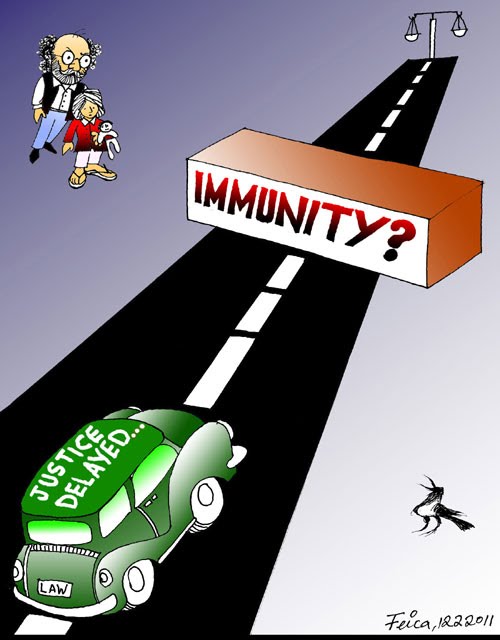
Friday, February 25, 2011

MONEY IS NOT EVERYTHING

Money cannot solve everything. It looks as if the richest monarchy in the Arab world and the largest global oil exporter, Saudi Arabia, may be getting jittery at the history-changing events developing across the Middle East. The ouster of decades’ long autocratic rule in Tunisia and Egypt and the wave of protests sweeping across Bahrain, Yemen and Libya have prodded Saudi Arabia into action to placate an ever-increasing disillusioned public.

Returning home after three months spent abroad for medical treatment, King Abdullah announced an extravagant aid package — to the tune of $ 35 billion — aimed at benefiting lower and middle income groups and unemployed youth, and addressing housing problems and high-inflation rates besetting the Saudi economy. This is an attempt by the Saudi monarchy to throw money at the problem as though that is all that is required. The Saudi monarchy is watching closely the rising stem of revolts in the Arab world, deeming it necessary to address issues before the people take to the streets of Saudi Arabia. As most of the reforms in the package aim to address the woes of the youth, it is quite obvious that the Saudi rulers have taken note of the fact that it is the tech-savvy youth demographic that is most active and passionate in the Arab protests.

The Libyan uprising has been reduced to an isolated, hate-spewing dictator watching his iron-clad grip quickly loosening in the face of angry protests and Yemen is seeing nine ministers resign from public office. Inspired by Tunisia and Egypt, the Arab public has finally decided that it has had enough of autocratic regimes, and no place epitomises a seemingly unshakeable monarchy like Saudi Arabia.

There have long been opponents of the Saudi regime but they have always been silenced by the kingdom’s repressive laws and policies. Many political opponents and underground groups have long demanded more gender equality, free elections to municipal councils, etc. However, for a theocracy like Saudi Arabia, introducing reforms that endanger the political-religious status quo will be out of the question. While this aid package is a premeditated move to curb any rising dissent within the kingdom, it must be asked: how far will doling out money go if it is not accompanied by freedom? Money can only go so far when the inhabitants of an oil-wealthy country are boiling over with frustration over the denial of their political, civil, human and gender rights.

Thursday, February 24, 2011

GADDAFI is too 'MUAMMAR' for state affairs, believe Libyans

A defiant Muammar Gaddafi vowed on Tuesday to die ‘a martyr’ in Libya on state television. He further added that he would call the people to cleanse Libya house-by-house unless protesters surrendered. It is important to note here that this is the first time Gaddafi announced his stance publicly since the revolt broke out. Recently, a lot of rumours were flying that Gaddafi had fled; perhaps he thought that it was important to give a public appearance in order to refute all such rumours.

Nevertheless, it is evident that Gaddafi’s regime is crumbling: at least seven Libyan ambassadors are no longer supporting him; his justice minister has resigned; the staff of Libya’s mission to the UN has declared allegiance to the people of Libya; two senior air force fighter pilots defected and flew their jets to Malta when asked to attack protesters. Even his soldiers have turned against him after the people came out on the streets demanding regime change after over four decades of his rule. Moreover, Gaddafi has virtually lost all his strength in the eastern coast and therefore resorted to the oldest trick in the dictator’s book — a brutal crackdown on protesters. On Monday, pro-regime militiamen shot on sight anyone found in the streets and opened fire from speeding vehicles at people watching from the windows of their homes. Almost 62 civilian casualties have been reported in Tripoli in the last two days.

The problem with Gaddafi, like most other dictators who have been in power for a long time, is that they never read the writing on the wall. The thought of giving up never crosses their mind. So much so that they do not even hesitate to massacre their people to prolong their rule. The UN Security Council held an emergency session, and western diplomats pushed it to demand an end to the retaliation against protesters. In addition, the French foreign minister, UN chief and UK foreign secretary strongly opposed the attacks on protesters. In the light of all this, it is becoming quite clear that Gaddafi will not be able to survive. Everyone is waiting for Gaddafi to realise this and spare himself and the people more trouble. The time has come!

Monday, February 21, 2011

TUM TO MUJHAY AZIZ HO 'NASWAAR' KI TARHA

Bahein galaay may daal kay kehta tha 'Raymond Khan'
'Tum to mujhay aziz ho Naswaar ki tarha"!

The United States government was unaware that Raymond Davis was hooked on ‘naswar,’ and in all probability he is now undergoing withdrawal symptoms, unless there is a friendly guard nearby to offer him some, or the jail doctors recommends weaning him away from what is a legal form of tobacco.

When the US Embassy was approached, they appeared unaware of Davis’s ‘desi’ addiction. Abrupt stopping of ‘naswar’ intake can be uncomfortable as junkies discover, if they are without their hourly ‘fix’. Withdrawal symptoms include headache and anxiety and anger.

According to a Bannu shopkeeper, the price of one packet of Bannu Naswar is Rs7. “One packet is enough for thirty pinches of ‘naswar.’

According to the challan by the city police in Lahore, a packet of ‘naswar’, was also recovered from Davis’s car, amongst other personal and lethal items that an undercover agent on active duty is expected to have with him at all times. US troops stationed inside Afghanistan are known to enjoy ‘naswar’ and have become hooked to it. Davis in all probability must have picked up the habit during his long stays in Khyber Pakhtunkhwa. It also reflects on the company he was keeping at the time. The problem of ‘naswar’ like chewing ‘pan’ is that one has to spit it out after a while.

Whether the Americans including Davis have found a socially correct way to deal with this aspect is unknown or did he spit it out of his car window?

According to Wikipedia, ‘naswar is held in the mouth for 10 to 15 minutes. If it is chewed it produces a bad taste in the mouth. Usually, the consumption varies but mostly people take it on an hourly basis.’ It is primarily used in Central Asia, Iran, Afghanistan, Pakistan, Tajikistan, Sweden and India.

“Once I was sitting next to a Norwegian at a meeting in Europe and was surprised to see him enjoying ‘naswar’”, a Pakistani diplomat told The News. It is predominantly used by members of the Pashtun ethnic groups. Nowadays people of other regions i.e. Punjab, Sindh and Baluchistan also use it and the number of addict people is increasing day by day.

Some of the great varieties of naswar are found in different parts of Khyber Pakhtunkhwa province in Pakistan, but Bannu is especially famous for it. There are different brands of ‘naswar’ in the provinces such as “Toor Khamar”, “Missile”, “Safarish Khan”, “Lucky” etc. Toor Khamar ‘naswar’ is prepared in Shahbaz Garhi, Pakhtoonkhwah, while Safarish Khan and Lucky are prepared in Havelian, Pakhtoonkhwah and Abbottabad, Hazara Division, Pakhtoonkhwah.

The News received telephone calls from the Fata area, and two calls from Waziristan when this correspondent had in an international Pushto programme, mentioned Davis’s love for ‘naswar’. “This is the only good thing we have heard about this American killer. We are glad that he has picked up this healthy habit from his Pushtun friends and acquaintances,” said a gentleman who identified himself as Wazir Khan.

Some of Khan’s friends had this to say, “So much attention is being given to three boys killed in Lahore by an American. What about the Pakhtuns who are being killed like flies by US drones? What will it take to get kind of worldwide attention?”
Courtesy Mariana Babar, The News

Sunday, February 20, 2011

LAHORE SHOOTINGS- UN ANSWERED QUESTIONS!

A court in Pakistan has delayed a hearing to decide whether an American who shot dead two men in Lahore last month has diplomatic immunity. The arrest of Raymond Davis has severely damaged relations between the countries. Much of the detail in the case remains unclear - the BBC's Syed Shoaib Hasan looks at some of the unanswered questions.

Is Raymond Davis a diplomat?

If you are thinking of a suavely dressed man in a three-piece suit who holds meetings with local officials to further or broaden his country's agenda, you would be wrong. Mr Davis was definitely not employed for his diplomatic skills - he is more a "hands-on" person, working in what the US embassy says is its "administrative and technical affairs section". Reports from the US say he is a former special forces soldier who left the military in 2003 and is working for the US embassy in Pakistan. As such, the US insists he is covered by the Vienna Convention which guarantees immunity from prosecution for all diplomatic staff.
Could he be a spy?

Many Pakistanis believe he is - there seem few other credible explanations as to why he was going around Lahore with a Glock pistol in a car with local number plates without informing local authorities. It is a requirement for embassy staff - especially those from Western embassies - to inform local police of their movements, simply because they are prime targets for militants in Pakistan. Mr Davis's department in the US embassy is widely seen in Pakistan as a cover for Central Intelligence Agency (CIA) operations. Mr Davis himself said he was a consultant employed by the US government. Researchers in the US say that since leaving the military, Mr Davis worked for a security firm called Hyperion LLC. But subsequent investigations by the US media have now shown that Hyperion exists only as a website. The offices that the company says it has in Orlando have been vacant for several years and the numbers on its website are unlisted. Mr Davis insists he was acting in self-defence.

Can Mr Davis be convicted for the murders?

Maybe. It all depends on how eager the Pakistani authorities are to punish him. The fact that he is possibly a spy does not mean he is not covered by diplomatic immunity. It is common practice for intelligence services across the world to send operatives under the cover of assignments to embassies. Both Pakistani and US "diplomats" have been caught in such situations - and every time have been asked to leave the host country immediately with no possibility of a return. That is the maximum punishment that has been levied in the overwhelming majority of cases in countries which have signed the Vienna Convention. However, in some countries there are exceptions for serious offences committed, such as murder. Pakistan is one of those countries. The matter is now in the hands of the judiciary. But it is important to remember that Mr Davis has been charged with murder - the maximum sentence here is the death penalty.

Should Mr Davis have been carrying a gun?

Legally speaking, only Pakistani citizens with licences issued by the interior ministry are allowed to carry arms. No foreigner is allowed to carry arms, except soldiers or guards within the premises of an embassy. Both Pakistani nationals and foreigners caught carrying arms can be charged under a Pakistani criminal law which stipulates a jail term of six months to two years in addition to a fine. Mr Davis has also been charged under this law. Matters were further inflamed by the suicide of the widow of one of the men killed by Mr Davis.

Was he acting in self-defence?

That was the initial plea made by Mr Davis and the US embassy. However, subsequent investigations by the police, forensic labs and the local and international media suggest that the two men were driving away from Mr Davis when they were shot. In February Lahore's police chief said that Mr Davis was guilty of "cold-blooded murder" - he said that no fingerprints had been uncovered on the triggers of the pistols found on the bodies of the two men. Furthermore he said that tests had shown that the bullets remained in the magazines of their guns, not the chambers, suggesting they weren't about to shoot him. On the face of it, this leaves Mr Davis's claim that they were robbers - with one even apparently cocking a gun at his head - looking very thin. In addition, police say ballistics evidence shows that the pair were shot in the back - which again suggests they were moving away from Mr Davis, rather than about to attack him.
Who were the Pakistanis that Mr Davis shot?

In his initial statement, Mr Davis said they were robbers who were trying to steal his valuables. He and the US embassy have maintained this story. However, the men have no criminal records as such. Both have been identified as residents of Lahore by the police. The pair were carrying licensed pistols - a fact which led many to believe they might indeed have been robbers. However, security sources in Lahore say that they were part-time or low-level operatives for the local intelligence services. Although reports are sketchy about what they were doing in relation to Mr Davis, security officials believe it could be the case of a surveillance operation gone horribly wrong. Pakistani intelligence services routinely tail and monitor all embassy staff, Western or otherwise. A third man on his motorbike was killed in the incident by a mystery US car

What about the second car and its victim?

A side event to the main drama concerning Mr Davis was the fact a third man was also killed during the incident. He was an innocent bystander run over by a US embassy vehicle, which was initially said to have arrived to rescue Mr Davis. The fact that an embassy vehicle was able to get to the spot so quickly was a source of astonishment to anyone who is even vaguely aware of the geography of Lahore. Given the incident was over within minutes, it seems incredible that anyone could negotiate the 12km (7.4-mile) 40-minute drive in peak traffic in less than five minutes. But subsequent investigations have now shown that the second car - a Toyota Landcruiser - was with Mr Davis at the time of the incident. In fact, according to eyewitnesses, Mr Davis was leading and clearing the way for the Toyota when the incident took place. In the light of what happened afterwards, it seems Mr Davis was in "protective mode" and opened fire to "secure" whoever or whatever was in the Toyota - the interior of this vehicle was not visible as its windows were tinted. It is evident in local TV footage that the second vehicle is going away from Mr Davis at the time of the incident. As it disappears into the dust, Mr Davis calmly pulls over and gives himself up. Pakistani authorities have asked for the Landcruiser and its driver to be handed over - a request with which the US has yet to comply.
What about behind-the-scenes negotiations?

As well as public pressure, US officials have also privately warned Pakistan's government of far-reaching and severe consequences if Mr Davis is convicted. Unnamed US officials have also used the media to issue veiled warnings to Pakistan that diplomatic ties could be cut and all aid stopped. Despite Islamabad's public stance on Mr Davis, Pakistani officials are said to have privately assured Washington that he will eventually be released. However, public pressure means that at the moment this could lead to a massive anti-government backlash. Pakistan's Prime Minister, Yousuf Raza Gilani, has hinted that blood money could be paid to the families of the two men Mr Davis admits shooting, which could enable his release. There is speculation that US officials may try to establish contacts with the families in this regard. However, it is not clear that Mr Davis has been charged under laws which would allow blood money to be paid.

LONG LIVE PAK-US RELATIONS!

HIT-&-RUN KILLER REACHES BACK USA

An American driver and another person whose vehicle crushed a Pakistani motorcyclist to death in Lahore as they were rushing to the aid of Raymond Davis, who had committed double murder, have slipped out Pakistan and are back on American soil, a senior US official told an American television network.

The American sought for arrest after a court order, who the State Department only identified as a member of the US embassy’s staff in Islamabad, Pakistan, was behind the wheel when he struck and killed a bystander while speeding to the area where shooting took place. The driver of the vehicle held the same “diplomatic visa” as Davis, US officials told ABC News. Since his arrest, the US argued that Davis should be afforded diplomatic immunity as a member of the embassy’s “technical and administrative staff” and released.

Authorities in Punjab said they sent five letters to the US Embassy asking that the driver and vehicle be handed over, but have reportedly received no response. It is unclear when the driver and his passenger were spirited out of Pakistan, but a senior US official said it happened soon after the shooting incident, the report said.

Meanwhile, State Department spokesman Philip Crowley declined comments when asked whether the Americans sought by Pakistani authorities were still in Pakistan. “I’m not going to comment,” was all he said.

Friday, February 18, 2011

TIME TO MOVE FORWARD

Courtesy Daily Times Feb 18, 2k11 The Raymond Davis affair has, unfortunately, blown up into a full political crisis. Instead of remaining a legal matter concerning only the Foreign Office and relevant government authorities, it has entered the domain of public discourse and cheap political manhandling. Much has been said and commented about the American who still cuts a shadowy figure. However, it is being pressed upon the Pakistani government that murderer or not, Raymond Davis holds a diplomatic passport and, as signatories of the Vienna Convention of 1961, it is implicit upon us to acknowledge that he enjoys diplomatic immunity as stated in international law. Senator John Kerry, on his recent one-day visit to Pakistan emphasised as much: international law supersedes the dictates of our local courts. The senator came to Pakistan in what can best be described as a damage control exercise. He spoke lucidly, candidly and politely but he did not refrain from conveying the underlying message: that Pakistan and the US must act responsibly to resolve this unfortunate incident. That, in the end, is what the entire debacle boils down to. We must set our emotionalism and raging sentiments aside and converge at a point where national interest is not put at stake. Ever since Raymond Davis shot two men in Lahore last month, the governments of both Pakistan and the US have mishandled the case in varying proportions. The Pakistani government, without considering the huge risks associated with the case, did not take into account the fact that Davis could very well be a diplomat (which the Foreign Office has also confirmed) before putting him in the lockup and proclaiming to the media that the courts would handle the issue. The US, on the other hand, asserted itself too aggressively when it insisted initially that Davis enjoyed full diplomatic cover before producing proof for their argument. Even now, if the brothers of Davis’s victims are to be believed, the US offered them ‘blood money’ — dollars and green cards — to drop the case. This is no solution and the US itself needs to act responsibly and cautiously. For all its premature huffing and puffing, the government in Pakistan now finds itself between a rock and a hard place. Its awkward position is such that if Davis is not released, vital assistance and ‘friendship’ with the sole superpower will be put at stake and if he is released, the public backlash in Pakistan could shoot through the roof. It is not a walk in the park for the US either as it cannot afford to simply drop Pakistan from its list of allies like a hot potato. The gains made in the war on terror and the threats to NATO supply routes that run through Pakistan are all huge costs if ties are broken. That is why Senator John Kerry’s soft-spoken entrance to soothe the potential fallout came as a welcome break from the high-pitched emotionalism that has rocked this case to and fro. It must be mentioned that the senator did offer a consolation prize. If the Foreign Office, and officials of both governments cooperate and engage in a rational way and hand over ‘the diplomat’, Raymond Davis, to his country, Kerry assured us that complete criminal investigations would be carried out on US soil. This is considerably far more than what we have been offered by the US so far and, if better sense prevails, we ought to move forward to bring this whole sorry affair to a close. As far as any public reaction to responsible action is concerned, the right-wing only needs an issue to exploit and the Americans have given them some juicy ammunition. Now that the blasphemy issue has died down, Raymond Davis is the perfect pawn for street agitation. The Pakistani government is no stranger to right-wing agitation and, if handled cautiously, this issue too will eventually die down.

Thursday, February 17, 2011

RAYMOND DAVIS, HIS TRICKS & SECTION 302

By Mahtab Bashir
mahtabbashir@gmail.com
Islamabad

Many opine that Pakistan will not have to face any kind of negative consequences in case it refuses to release Raymond Allen Davis- a killer of two ‘innocent’ Pakistanis, despite growing US pressure. They are of their views adding that even isolation of Pakistan in the comity of nations would be a blessing in disguise and the Islamic Republic would emerge as a stronger country. If tiny countries like Cuba and North Korea could withstand pressures, there was no reason why Pakistan could not do so!


The challan submitted by the city police against US national Raymond Allen Davis in a court reveals that the accused tried to cheat the police by concealing the facts.

The challan reads that “Davis continuously told lies to the investigation team and completely refused to help them reach the facts, saying that the American consulate had directed him not to reply to any query of the police”.

The text of the incomplete challan submitted in the court is being produced here:

“The case was handed over to Lytton Road Police Station In-charge Investigation Inspector Muneer Ahmad. During the investigation, the inspector took the dead bodies of the two (victims of Davis) – Faizan Haider and Faheem Shamshad – from the emergency ward of the Services Hospital and in the guard of policemen sent them to the mortuary. Lytton Road Police Station SHO, Atif Meraj Khan, took the belongings of the dead and other material in his custody and got them registered in fardats (the relevant papers) and handed over to the investigation officer. The detail of the things is as follows: one belt, one pistol pouch, one handbag, two wallets, five mobile phones (Nokia 18910, Samsung, A1303, Sony Ericsson T 700, Nokia 1616, 6300), Pakistani and foreign currency (Yen 58,915, Omani Baisa 1100, Piso 10), two national identity cards bearing Faizan Haider and Zohra Shahzad’s names and different pieces of papers. Later, the IO visited the crime spot and took in possession the following things: the deceased persons’ Honda motorcycle bearing number LOV 4030, the blood of the two deceased on cotton buds, two pistols of 30 bore belonging to the deceased, pieces of shattered windowpanes of the accused’s vehicle, two empties, a 9mm pistol.

They were sealed and registered in relevant documents. The IO drew a rough sketch of the crime scene and recorded the statements of eyewitnesses. The witnesses said that the accused first shot at the deceased from inside his car and then came out of the car and fired two shots at Faizan Haider from the back. He took pictures of the dead Faheem and then called someone through his wireless to rescue him. The witnesses, traffic wardens Muhammad Hussain and Waqas Khaliq, told the IO that when the accused (whose name, according to his passport, is Raymond Allen Davis) ran from the crime scene in his car (Honda VTI) bearing number LEC-10/5545, they chased him and managed to overpower him at Old Anarkali Chowk and with the help of local police handed him over to Old Anarkali circle DSP, Raza Safdar Kazmi. The police also took in possession the following things from the custody of the accused: 9 mm Glock pistol, five magazines, 78 live bullets of 9mm, a passport, a long-range wireless set, global positioning system (GPS) with charger. From the car of the accused, the police took in possession the vehicle’s registration book, four empties of 9mm, two mobile phones, a telescope, an infrared light, a digital camera, a cutter, head torch, small torch, survival kit, memory card, 19 cards of different nature, a packet of niswar, Rs 5,805 and $126 in cash, ATM card, a PIA ticket, receipts of money changer and Bank Al-Falah, chit of the embassy, blank cheque of Federal Saving Bank, USA, etc.

All things were recorded while the two traffic wardens signed the papers as witnesses. The IO collected all these things from the custody of the Old Anarkali circle DSP and now this all material is being sent to the federal government through the Ministry of Interior for action and research. The DSP handed over a hand-written statement of the accused, written in the presence of the DSP, to the investigation officer. This statement reads that when the accused “halted his car at the traffic signal of Qartaba Chowk, one of the two motorcyclists pulled his pistol at him. He took out his pistol and fired at them in self-defence. The driver of the motorcycle ran away and the second fell on the motorcycle. He came out of the car and took three pictures of the boy and informed his embassy for his rescue”. He also said that when people gathered he managed to escape with his car.

The investigation officer inquired from the accused and he verified his statement word to word. The accused was officially taken into custody in this case and was shifted to a safe place for his security. A Land Cruiser which came to rescue Davis violated the one-way and ran over a citizen Ibadur Rehman. The Land Cruiser, which had a fake number plate, LZN-6970, while moving recklessly went to the US consulate. Different things fell off the Land Cruiser, and were found near the Faletti’s Hotel and Shimla Hill. These included: four magazines, 100 bullets, four battery cells, a scissor, a pair of gloves, compass with knife, battery, black coloured mask, a piece of cloth having American flag, special battery, small stick with pouch, a piece of iron, cloth bandage, a cloth magazine bag.

The FIR number 48/11 was registered on January 27 in the Lytton Road Police Station under Sections 302/34/427. On January 29, the dead bodies of the deceased - Faizan Haider and Faheem Shamshad - were handed over to their families after autopsy for burial. The accused, Raymond Davis, was produced in the court of Muhammad Zafar Iqbal Sial, judicial magistrate, with the written permission of district and sessions judge, Lahore. Davis was remanded for six days. The special investigation team formed to look into the case interrogated the accused and he could not produce licence of the pistol and another case, 49/11 of carrying illegal weapon was registered against him. The map of the crime scene was made. The postmortem reports of the deceased were received and according to that report the deceased Faizan Haider received five arm injuries. Two injuries were on the backside left buttock near the spinal cord and three in the front - right side of the chest, two on the left thigh. The deceased Faheem also got five arm injuries – two injuries on the back side in lumber area. One bullet entered the left elbow and crossed in front, second entered in the head from the upper side of the ear and third entered from the left side of the belly and came out from the right and another bullet hit the left thigh. The parcels of the material related to the case have been submitted to a chemical examiner and the Forensic Science Laboratory.

The car used by the accused is the property of one Sohail Nisar, a resident of Gulberg, who has given it to a company ‘Capital Car Rental’ and the company has given it on rent to American consulate on annual basis. The car has also been sent for forensic examination. On 11 February, on the conclusion of physical remand, the accused is being sent to jail on judicial remand.

During investigations it has come to light that the stance of the accused that he fired in self-defence is not correct on the following grounds: The postmortem report says that (1) Faizan and Faheem received three injuries each from the back side. (2) witnesses say that the accused fired at Faizan Haider at a time when he left the motorcycle and ran to save his life (3) the accused himself admitted that he fired at Faizan from the back when he was running (4) two empties recovered from the crime scene prove that the accused fired at the deceased after coming out of the car (5) the accused claims that one of the deceased cocked his pistol and pointed at him while the investigations reveal the chamber of the deceased’s pistol were empty and the bullets were in the magazine. And no one saw them aiming at the accused. (6) if the accused had to fire in self-defence he could fire at the lower part or legs of the deceased as he was an expert at using arms.

The accused has said in his written statement that he was coming from the embassy while the GPS record says that he was coming from his private residence at Scotch Corner, Upper Mall. The accused has concealed the fact. He refused to reply to any question during investigations, saying the American consulate had forbidden him to answer any question.

The blood samples are examined and proved that it is human blood. A forensic expert has confirmed that the empties had been fired from the same pistol recovered from the possession of the accused. The statements of the witnesses, recovery of weapon, and other evidences prove that the accused Raymond Allen Davis is guilty of committing a crime under section 302 of the Code of Criminal Procedure and an incomplete challan is being submitted against him. It is requested that the case be heard”.

DARE-RC SUMMIT CALLS FOR EVIDENCE-LED TRANSFORMATION IN PAKISTAN’S EDUCATION

The two-day DARE-RC International Education Summit stressed that data, research, and classroom realities must guide education policy in Paki...